
A Full Guide To ISO 27001 Certification In Malaysia
In Malaysia, an organisation receives ISO/IEC 27001 certification when an accredited independent certification body verifies it has an information security management system (ISMS) that satisfies the international standard.
As readers likely know ISO 27001 is not mandatory but have reason to obtain it, our guide sticks to the practicalities of getting certified, broken down into:
- the role of a certification body
- eligibility requirements
- supporting ISMS documentation
- steps in the certification process
- how ISO 27001 supports PDPA compliance, and
- certification costs
Of course, you’re welcome to skip the guide and get in touch for help!
Otherwise, let’s begin.
Note: We share the templates and examples below to give you more clarity, not to encourage their use, as your choices and justifications must reflect your own risk assessment.
The role of a certification body
If this is your first ISO certification, the actual certification is carried out by independent certification bodies accredited by the Department of Standards Malaysia.
There are many such bodies in Malaysia, each allowed to set their own fees, application processes and requirements (so long as they comply with ISO standards).
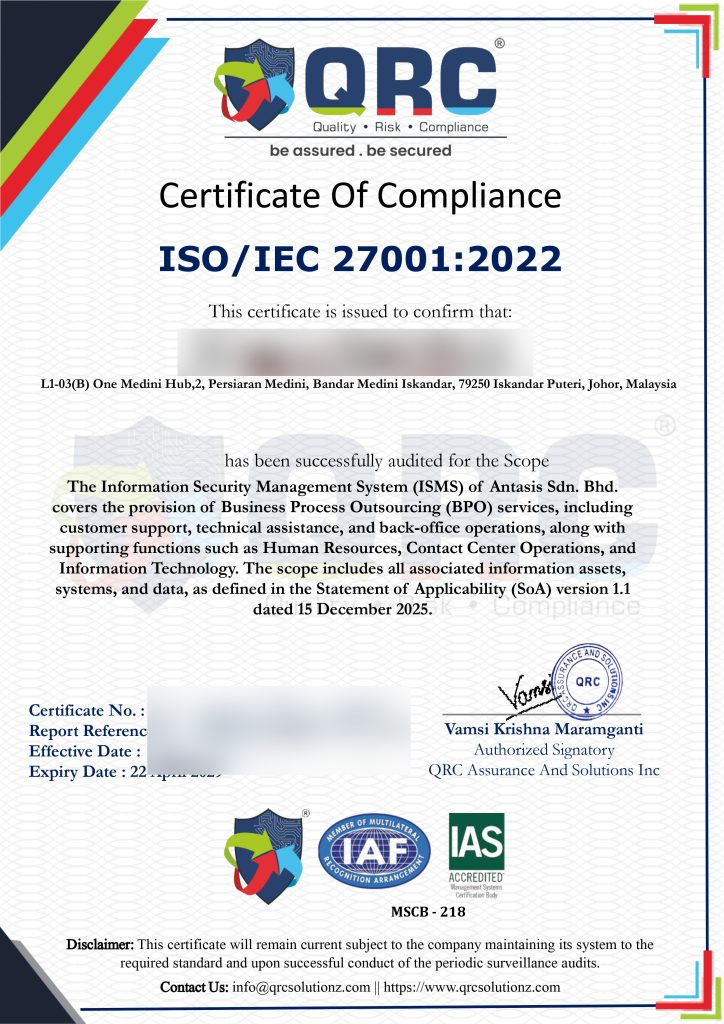
These bodies are required to remain impartial and forbidden from helping you develop your ISMS in any way. Instead, their role is always strictly to:
- audit your ISMS against the requirements of ISO 27001
- raise any nonconformities it finds for you to address
- recommend and issue your certificate once all requirements are met, and
- carry out surveillance and recertification audits to keep your certificate valid
For help developing a compliant process and documentation, you’d need to engage an ISO consultant separate from the certification body that audits you.
Eligibility requirements
Any organisation in Malaysia, regardless of size or sector, can be ISO 27001 certified, so long as it has an ISMS that meets the standard as set out in ISO/IEC 27001:2022.
This doesn’t necessarily mean you need an operational ISMS when you apply, but before a certification body can recommend you for certification, you must demonstrate:
- a defined scope covering the systems, locations and information included, and an information security policy signed off by top management
- an information security risk assessment and a risk treatment plan
- a completed Statement of Applicability
- information security objectives with measurable targets
- records showing the system has been operating for a period of time
- at least one full internal audit and one management review completed
As part of this process, every applicant must decide which security measures apply to them by choosing from a list of 93 options known as Annex A.
Annex A
Annex A is a list of 93 possible security measures under ISO 27001, and a full list would be longer than this guide, so we’ll link to the 93 controls under Annex A for those who want to learn more.
Briefly, Annex A’s 93 controls are grouped into four themes:
| Theme | What it covers | Examples |
|---|---|---|
| Organisational (37 controls) | the rules, policies and responsibilities for managing information security | information security policy, supplier security, incident management |
| People (8 controls) | how staff are hired, trained and managed when it comes to handling information | background checks, security awareness training, confidentiality agreements |
| Physical (14 controls) | protecting premises and equipment where information is stored or handled | office access control, secure server rooms, clear desk rules |
| Technological (34 controls) | protecting IT systems, networks and software | user access rights, malware protection, backups, encryption |
It works like a menu as the applicant picks the controls that address your own risks rather than applying every one, though of course most businesses will need to apply controls from all four themes.
Your chosen controls, exclusions, and justification are recorded in a Statement of Applicability (SoA).
Statement of Applicability
The SoA sounds intimidating, but it isn’t complicated so much as it is just long, as it’s essentially a table with one row for each of the 93 Annex A controls.
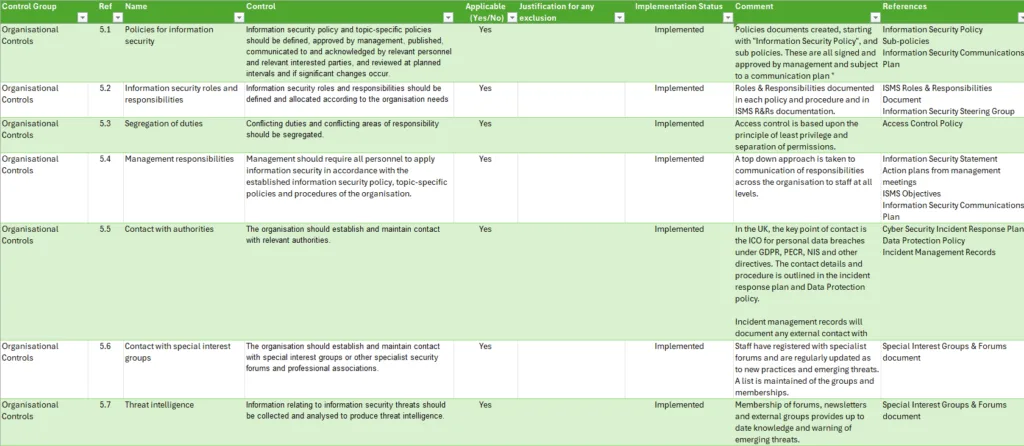
For every control, the key inclusions are:
- applicability: whether the control applies to your organisation
- justification: why you included or excluded it
- implementation status: whether the control is implemented, in progress or not yet implemented
Many SoAs also record who owns each control, where the supporting evidence can be found and when it was last reviewed, though these are optional. Auditors focus most on your exclusions, so make sure each one has a clear reason behind it. For a better understanding, see this Statement of Applicability template.
The controls you choose should then be addressed in your ISMS documentation.
ISMS supporting documentation
Your ISMS documentation is a list of all the information ISO 27001 requires you to make available.
This falls into two types:
| Type | What it means | Examples |
|---|---|---|
| Documents | living documents you keep up to date | scope of the ISMS, information security policy, risk assessment and treatment process, Statement of Applicability, information security objectives, access control policy, incident management procedure, business continuity plan |
| Records | evidence that something happened | staff competence and awareness training, risk assessment results, user access reviews, security incident logs, backup and monitoring records, supplier security reviews, internal audit programme and results, management review results, nonconformities and corrective actions |
Many organisations compile the core of this into an ISMS manual, though for ISO 27001, the SoA and risk treatment plan are usually what auditors examine most closely. Like all good documentation, it doesn’t have to look fancy, but it does have to be complete.
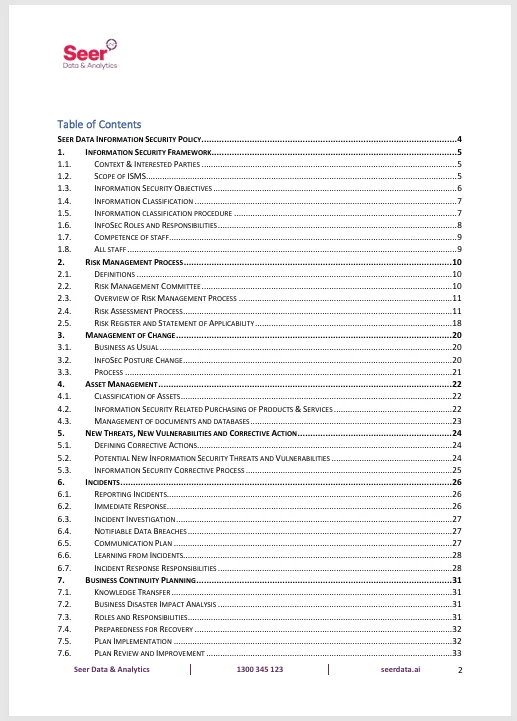
For an example, see this sample ISMS manual from a data-sharing firm in Australia.
With that covered, let’s look at the certification process itself.
Certification steps
Each body sets its own specific process, but there are generally seven main steps:
| Step | Stage | Description |
|---|---|---|
| 1 | Questionnaire | Submit the questionnaire in the application package so the certification body can prepare a quotation. |
| 2 | Application | Accept the quotation, then submit the application form with the application fee. An audit team leader is appointed to your file. |
| 3 | Stage 1 audit | The auditors check your ISMS documentation and whether you are ready for Stage 2. |
| 4 | Stage 2 audit | Once Stage 1 findings are resolved, the auditors assess how well your ISMS is implemented and how effective it is. |
| 5 | Recommendation | After any nonconformities are verified as closed, the audit team leader sends a recommendation report to the Certification Panel. |
| 6 | Approval | The Certification Panel reviews and approves the recommendation. |
| 7 | Certificate | The certificate is issued once all fees are paid and the Certification Agreement is signed. |
How long this takes depends on the size of your operation, but as a general estimate, expect it to take 3 to 6 months.
Let’s go over some of these steps in slightly more detail.
Stage 1 audit
The Stage 1 audit is a paperwork stage to see if your ISMS documentation is adequate enough for you to proceed to Stage 2. Auditors will typically review your:
- scope
- information security policy
- risk assessment and risk treatment plan
- Statement of Applicability, including any excluded controls, and
- objectives
They then confirm that internal audits and management reviews are planned or done.
Stage 2 audit
The Stage 2 audit is a site visit to evaluate how your ISMS is implemented and where auditors verify that what your documents say is actually happening, so expect them to:
- check how user access is granted, reviewed and removed
- verify that backups are taken and can be restored
- review your security incident logs
- inspect the physical security of offices and server rooms
- interview staff on their security awareness, such as how they spot phishing
- review how you control cloud and IT suppliers, and
- compare your records against your procedures
The audit team leader then prepares a recommendation for certification.
Or, more likely, they raise some issues first!
Addressing nonconformities
No matter how carefully you prepare, chances are the auditors will find areas that don’t meet the standard. These are raised as nonconformities, usually graded as:
- minor: an isolated lapse that doesn’t undermine the system as a whole
- major: a requirement is not met at all, or the system has broken down in a way that puts its results at risk
You will be given a deadline to respond with a correction and a corrective action plan that fixes the root cause. Certification bodies set their own response deadlines, so check your audit report.
The audit team leader will only recommend you for certification once your nonconformities have been verified. If the follow-up shows no further issues, your certificate will be issued, which is valid for three years.
And now you have your certificate, let’s see what it takes to keep it.
Surveillance audits
Once certified, you will have one surveillance audit every year (twice a year in exceptional cases) to confirm your ISMS is still being properly implemented and improved.
Surveillance audits are shorter than the initial audits and focus on sampled areas, recent changes, security incidents and progress on your objectives.
Validity and recertification
Briefly, an ISO 27001 certificate is valid for three years, with a recertification audit in the third year that must be completed before the certificate expires.
Since your ISMS was already assessed during initial certification, recertification doesn’t start from scratch. Auditors review the system’s performance over the full three years and confirm it is still effective.
Next, let’s look at how all this ties in with Malaysia’s personal data law.
ISO 27001 and PDPA compliance
This goes outside the scope of the guide, but we think it’s important to highlight as Malaysian businesses seeking ISO 27001 certification often fall within thresholds of several mandatory obligations under the Personal Data Protection Act 2010 (PDPA).’
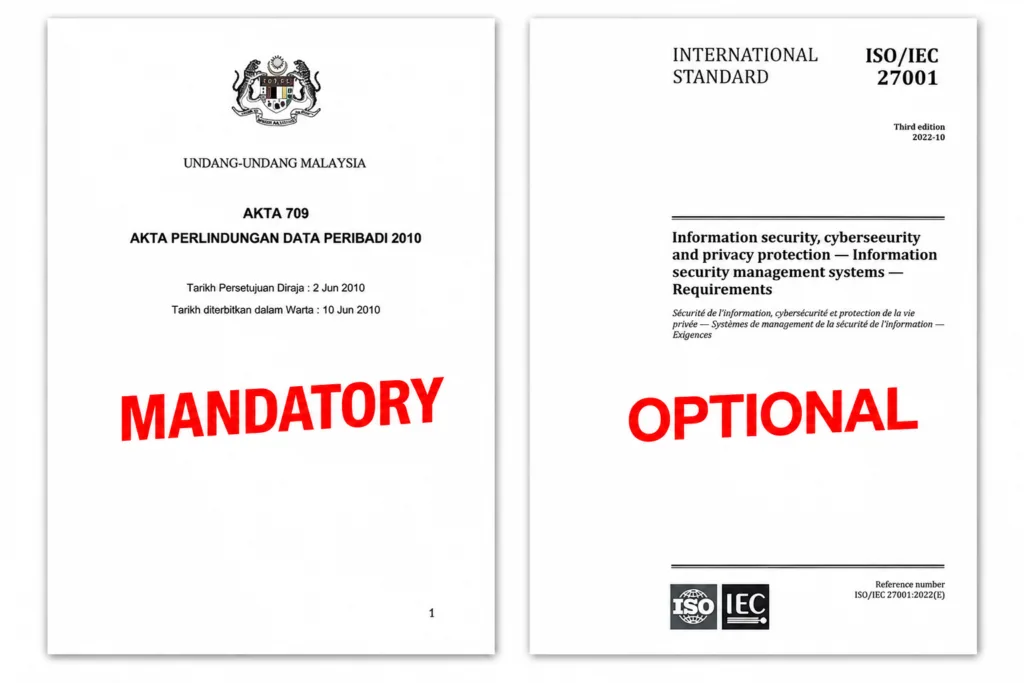
According to PDPA compliance solicitors Edwin Lee & Partners, these include:
- data controller registration
- appointing a data protection officer (DPO)
- timely data breach notification
- compliance with the PDPA’s 7 personal data protection principles
As ISO 27001 isn’t designed specifically for PDPA compliance, ISO certification alone would still leave empty boxes in one’s PDPA compliance checklist – here’s a quick overview:
| PDPA requirement | Covered by ISO 27001? |
|---|---|
| protecting personal data from loss, misuse and unauthorised access | yes, through your risk assessment and Annex A controls such as access control and encryption |
| reporting breaches within 72 hours | largely, as ISO 27001’s incident management controls give you a process to detect, assess and escalate breaches quickly |
| ensuring data processors protect personal data | largely, through supplier security controls and contracts |
| appointing a DPO | no, this must be done separately |
| consent, notices and data portability | no, these remain separate PDPA obligations |
Of course, wanting ISO 27001 certification doesn’t guarantee you fall under PDPA thresholds, it’s just very likely you do, so confirm if the thresholds apply to you.
If yes, then you’ll likely need support from a dedicated PDPA consultant.
Now we reach the last part, for which we apologise in advance, as it boils down to ‘it depends’!
Certification costs
There is no fixed fee schedule for ISO 27001 certification, and each certification body will quote you an estimate that depends on:
- organisation size
- certification scope, including the number of systems and locations covered
- number of employees
- location
- whether you’re applying for other ISO certifications at the same time
Most certification bodies have an enquiry form that makes it easy to enter your details and receive a quote, so submit a few to find the best deal. Based on our experience, if you will need the help of a consultant as well, be prepared to spend around RM100,000.
Additionally, once certified, you can claim a double deduction on your certification fees.
How double deduction works
Under Paragraph 34(6)(ma) of the Income Tax Act 1967, as long as your certification body is accredited by the Department of Standards Malaysia, you can deduct twice what you paid from your taxable income in the year of assessment the certificate is issued.
For example, if you spend RM20,000 on certification, you can deduct RM40,000 from your taxable income. At a 24% tax rate, that saves RM9,600; at 15% it saves RM6,000.
However, only fees charged by the certification body qualify. Consultant fees and capital expenditure (like hardware purchased to meet compliance requirements) don’t entitle you to double deduction – but they may still qualify for other tax benefits.
That’s it from us, and we wish you all the best with getting certified 😊
Let MISHU support your ISO 27001 certification

Directly and through our partners, MISHU assists operations in Malaysia with applying for licenses from district and federal agencies. Speak to us today if you’d like help getting your business ISO 27001-certified!