
308 Questions On Sdn Bhd Registration In Malaysia Answered By A CoSec
We need to explain why we felt the world needed a list of 300+ questions – click here to skip!
MISHU has been publishing content on company incorporation for many years, and our search data shows many niche questions that our general guides don’t quite address.
The more topics we cover, the more unanswered niche questions we find.

We’ve always wanted to publish a truly complete resource that answers everything in one place, from a reliable source, but doing it manually would have been impossible as we have lives to live.
But with Claude’s help, it goes from impossible to merely impractical…good enough for us!
So we fed Claude two years of internal search data and locked our human members in the office until every answer it prepared was personally reviewed and edited. Yes, it had to be the toilet.

It took us all night, but the result, we believe, is the most comprehensive resource on Sdn Bhd registration in Malaysia to date. May it answer your question and help you discover ones you didn’t know you should be asking!
Note: Use the table of contents to skip to a part and click on (↑) in the heading to come back to the table.
Table of Contents
- Sdn Bhd meaning & company types (↑)
- Choosing a business structure (↑)
- Sdn Bhd registration requirements (↑)
- Incorporation process & timeline (↑)
- SSM’s MyCoID & CRS platforms (↑)
- Superform & Section 14 (↑)
- Registration numbers (↑)
- Sdn Bhd costs & fees (↑)
- Share capital & paid-up capital (↑)
- Directors (↑)
- Nominees (↑)
- Shareholders & beneficial owners (↑)
- Company Secretaries 🤓
- Foreign ownership (↑)
- Foreign companies, subsidiaries & branches (↑)
- Labuan companies (↑)
- Sole proprietorships & enterprises (↑)
- LLPs & partnerships (↑)
- MSIC codes & nature of business (↑)
- Company bank accounts (↑)
- Tax registration & corporate tax (↑)
- Post-incorporation (↑)
- Business licenses & registrations (↑)
- Setting up specific businesses (↑)
- Dormant companies, strike off & winding up (↑)
- Buying an existing company (↑)
- Register a Sdn Bhd with MISHU
Sdn Bhd meaning & company types (↑)

This section covers what a Sdn Bhd is, how it compares with company types you might know elsewhere, and other kinds of companies in Malaysia. We suspect some of those asking questions in this section are SPM takers doing business studies, so if that’s you, all the best with your exams!
1. What does Sdn Bhd stand for?
Sendirian Berhad. It’s Malay for a private company limited by shares, and it’s by far the most common type of company in Malaysia.
2. What does Sdn Bhd mean in English?
Sendirian means private and Berhad means limited, so in English a Sdn Bhd is simply a ‘private limited’ company.
3. Is a Sdn Bhd the same as a private limited company, a Ltd or an LLC?
Pretty much. A Sdn Bhd is our version of a Singapore Pte Ltd or a UK Ltd. It’s close to a US LLC in that owners get limited liability, but it’s a company with shares rather than a member-managed LLC.
4. Is a Sdn Bhd a corporation?
Yes. A Sdn Bhd is a body corporate with its own legal identity, separate from the people who own and run it.
5. What is the difference between Sdn Bhd and Bhd?
A Sdn Bhd is private: it can have up to 50 members and can’t offer shares to the public. A Bhd (Berhad) is a public company that can raise money from the public, and it needs at least two directors who live in Malaysia. If you’re just starting out, you almost certainly want a Sdn Bhd.
6. Can a Sdn Bhd be a listed company?
Not as a Sdn Bhd. Only public companies (Bhd) can list on Bursa Malaysia, so a Sdn Bhd has to convert to a Bhd first. That’s a problem most founders would love to have!
7. What types of companies can you register in Malaysia?
Under the Companies Act 2016 there are four: private companies limited by shares (Sdn Bhd), public companies limited by shares (Bhd), companies limited by guarantee and unlimited companies. Sole proprietorships, partnerships and LLPs are registered with SSM too, but they aren’t companies.
8. What is a company limited by guarantee?
It’s a public company with no share capital, where members promise to chip in a set amount towards its debts if it’s wound up. It’s mainly used by non-profits, associations and foundations, and SSM charges RM3,000 to incorporate one.
9. What is an unlimited company?
One where the members’ liability for its debts has no limit at all. In our experience hardly anyone asks for one, and the SSM incorporation fee is RM1,000.
10. What does ‘(M)’ mean in a Malaysian company name?
It stands for Malaysia. Local subsidiaries of foreign groups often add it to tell themselves apart from the parent, as in ‘ABC (M) Sdn Bhd’.
11. What does ‘incorporated’ (diperbadankan) mean for a business?
It means the business is now registered as a company and exists as its own legal person. It can own assets, sign contracts, and sue or be sued in its own name.
12. What protection does a Sdn Bhd give its owners?
Shareholders are only liable for any amount unpaid on their shares, so their personal assets are generally safe from company debts. Directors aren’t completely off the hook though: fraud, wrongful trading and personal guarantees can still come back to them personally.
13. What are the advantages and disadvantages of a Sdn Bhd?
A Sdn Bhd has real benefits, but it also comes with more paperwork than simpler structures.
| Advantages | Disadvantages |
| Limited liability for shareholders | Higher set-up and running costs |
| Lower SME tax rates (15% on the first RM150,000) | A Company Secretary is mandatory |
| Easier to raise investment | Annual returns and financial statements to file |
| More credibility with banks and clients | Stricter record-keeping |
For most growing businesses we speak to, the liability protection and tax savings are well worth the extra compliance.
Choosing a business structure (↑)

Many searching for details on Sdn Bhds are still unsure whether they need one at all, so this section tackles questions comparing a Sdn Bhd with alternatives to help you pick the right one.
14. What is the difference between a business and a company in Malaysia?
A business (sole proprietorship or partnership) is registered under the Registration of Businesses Act 1956, and its owners are personally on the hook for its debts.
A company is incorporated under the Companies Act 2016 and is a separate legal entity with limited liability. That one difference drives most of the questions below.
15. What is the difference between an enterprise and a Sdn Bhd, and which suits a small business?
The two differ mainly in liability, tax and cost.
| Enterprise | Sdn Bhd | |
| Registration cost | RM30 to RM60 a year | RM1,010 in SSM fees, plus at least RM10,000 a year to run |
| Owner’s liability | Unlimited | Limited to any unpaid share capital |
| Tax | Personal rates of 0% to 30% | 15% to 24% for qualifying SMEs |
| Best for | Small, low-risk side businesses | Growing businesses with staff, contracts or investors |
Plenty of owners start as an enterprise and switch to a Sdn Bhd once the business takes off.
16. What is the difference between an LLP and a Sdn Bhd?
Both give you limited liability, but they’re owned and run quite differently.
| LLP | Sdn Bhd | |
| Owners | Partners | Shareholders |
| Company Secretary | Not needed | Required |
| Audit | Not needed | Required unless exempt |
| Running costs | Lower | Higher |
| Raising investment | Harder | Easier, by issuing shares |
| Recognition by banks, licensing bodies and Immigration | Less widely recognised | Widely recognised |
An LLP suits small, partner-run businesses. If you plan to grow or bring in investors, we’d point you towards a Sdn Bhd.
17. What is the difference between a conventional partnership and an LLP?
In a conventional partnership, every partner is personally liable for all the business’s debts and is taxed individually on their share. An LLP is its own legal entity, partners’ liability is limited, and the LLP itself pays the tax.
18. How do tax rates compare between an enterprise, an LLP and a Sdn Bhd?
Enterprise profits are taxed as the owner’s personal income at 0% to 30%. Qualifying SME LLPs and Sdn Bhds pay tiered rates instead:
- 15% on the first RM150,000
- 17% on the next RM450,000
- 24% on the rest
On a RM150,000 profit, an enterprise actually pays slightly less (RM21,900 vs RM22,500), and the two only meet at around RM157,500. Factor in a Sdn Bhd’s running costs and a sensible salary for yourself, and the real breakeven is closer to RM190,000 a year.
19. Is a Sdn Bhd more expensive to run than an enterprise?
Yes, by quite a bit. An enterprise costs RM30 to RM60 a year to renew. A Sdn Bhd realistically costs at least RM10,000 a year once you add a Company Secretary, accountant, tax agent and, unless you’re exempt, an auditor.
20. Should a restaurant or F&B business register as an enterprise or a company?
A small stall or single outlet often starts as an enterprise. Once you’re signing premises leases, hiring staff, opening more outlets or thinking about franchising, a Sdn Bhd is usually the safer bet because of limited liability.
21. Which business structure suits foreign investors best?
Almost always a Sdn Bhd. Foreigners can’t register an enterprise at all, and a Sdn Bhd is the structure most licenses and Employment Pass applications expect. Foreign parent companies can also look at a branch or representative office.
22. Can an enterprise operate under a Sdn Bhd?
Not as such, since an enterprise belongs to individuals rather than a company. A Sdn Bhd can, however, trade under a separate business name registered with SSM.
23. When should a business switch from an enterprise to a Sdn Bhd?
The usual triggers we see are profits high enough that personal tax overtakes company tax, taking on staff or big contracts, needing investors or bank financing, and applying for licenses that require a company. On tax alone, our maths puts the tipping point at around RM190,000 a year in profit, once you account for a Sdn Bhd’s running costs.
Sdn Bhd registration requirements (↑)

If you’ve determined a Sdn Bhd is indeed the right structure, legal requirements to register are fairly low, and this section covers essentials like director, shareholder, address, and supporting document requirements.
24. What are the requirements to register a Sdn Bhd?
To register a Sdn Bhd, you need:
- at least one director who ordinarily resides in Malaysia
- at least one shareholder
- a registered office address in Malaysia
- an approved company name
- a Company Secretary appointed within 30 days of incorporation
The director and shareholder can be the same person, so a one-person Sdn Bhd is perfectly possible.
25. How many directors does a Sdn Bhd need?
At least one, and that director must ordinarily reside in Malaysia, meaning their principal place of residence is here.
26. Can a Sdn Bhd have only one director?
Yes. A single-director Sdn Bhd is fine, as long as that director ordinarily resides in Malaysia.
27. How many shareholders does a Sdn Bhd need?
At least one and no more than 50.
28. Can one person be both the sole director and the sole shareholder?
Yes, as long as you ordinarily reside in Malaysia. You’ll still need a separate Company Secretary though.
29. Does a Sdn Bhd need a director who lives in Malaysia?
Yes. At least one director must have their principal place of residence in Malaysia. They don’t need to be Malaysian though: a foreigner living here on an Employment Pass, for example, can qualify.
30. What is the minimum age to be a company director?
18 years old.
31. Is a board of directors mandatory for a Sdn Bhd?
You need at least one director. With just one, that person effectively is the board, so there’s no need to fill a boardroom.
32. Who cannot be a company director?
You cannot be a director if you are:
- under 18
- an undischarged bankrupt
- disqualified by the court or SSM
- convicted of certain offences, such as fraud or dishonesty, within the past five years
Acting as a director while disqualified is an offence in itself, so this isn’t one to fudge.
33. Can a government servant open a Sdn Bhd or be a director?
Civil servants can generally hold shares, but being a director or running a business usually needs written approval from their head of department under the public service conduct rules. Get that approval before you do anything else.
34. Can I use my home address as the registered office?
Legally, yes, since any Malaysian address works. Many owners use their Company Secretary’s address instead to keep their home off public records, and local council rules on running a business from home still apply.
35. What documents do I need to register a Sdn Bhd?
Whoever handles your incorporation will usually ask for:
- a copy of each director’s and shareholder’s IC or passport
- their residential addresses and contact details
- the proposed company name
- the business activities
- the share structure
Foreign shareholders may also need proof of address.
36. Do I need a business plan to incorporate a company?
No. SSM doesn’t ask for one, although banks, investors and some licensing bodies might.
37. Should I rent premises before or after registering the company?
Usually after. Incorporating first means the tenancy can be signed in the company’s name, and most premises licenses need the company to exist before you can apply.
Incorporation process & timeline (↑)

Once you know you qualify, here’s how the registration itself works, from choosing and approving a name to what lands in your inbox when SSM registers the company.
38. How do I register a Sdn Bhd step by step?
Registering a Sdn Bhd follows these steps:
- Reserve the company name with SSM.
- Prepare the Section 14 application with director, shareholder and share details.
- Lodge it through SSM’s Corporate Registry System (CRS) and pay the RM1,010 fee.
- Receive the Section 15 notice of registration.
- Appoint a Company Secretary within 30 days.
- Open a bank account and register for tax.
Most owners have a Company Secretary handle steps 1 to 4, especially since you need one within 30 days anyway.
39. Can I register a company online?
Yes. Since mid-2026, incorporation is done online through SSM’s Corporate Registry System (CRS), a module on the SSM4U portal that replaced MyCoID.
You’ll need a verified SSM4U account first: locals verify at an SSM counter or one of the 500-plus Tap.it kiosks, while foreigners can verify online, usually within three working days.
40. How long does it take to register a Sdn Bhd?
Once your documents are in order, SSM usually registers the company within one to three working days. From first conversation to finished company, allow one to two weeks, and longer if you’re a foreign owner.
41. How long does SSM take to approve a company name?
Usually one to three working days. Reserving a name is optional and costs RM50 per name for 30 days, extendable up to 180 days, and you can reserve up to three names per application. Handy if you’ve found the perfect name but aren’t quite ready to incorporate.
42. How do I check if a company name is available?
Check for free on MYDATA-SSM, then search and reserve it through CRS on SSM4U, or ask your Company Secretary to do it. A name only counts as approved once SSM processes the application.
And if you’re not fussy, CRS can give you a pre-approved name like GI202609001234 Sdn Bhd, which saves a lot of time…but then good luck getting people to remember it!
43. What are the rules for naming a company?
It must end with ‘Sdn. Bhd.’, can’t be identical to an existing name and can’t be offensive or misleading. Words like ‘bank’, ‘insurance’ or ‘Islamic’ may also need sign-off from the relevant authority.
44. What kinds of company names does SSM reject?
Names that are identical or too close to existing companies, names that suggest a government link, offensive or undesirable names, and names using restricted words without approval.
You never can tell for sure, though, and so we always suggest having two – three backups.
45. Can I choose my company’s incorporation date?
Kind of, but not really!
The incorporation date is the day SSM registers the company, so you can time your submission, but you can’t backdate it.
46. Does it matter which state I register my Sdn Bhd in?
Not to SSM, which registers companies nationally. Where it does matter is local council licenses, signboards and premises rules, and Sabah and Sarawak also have their own work permit rules.
47. How soon after incorporation can I start trading?
Legally, from day one but in practice you’ll also need a bank account, tax registration and any mandatory licenses before you open the doors.
48. Can a company pay for costs incurred before it was incorporated?
Yes. Under the Companies Act 2016, a company can ratify contracts made on its behalf before it existed, and reasonable pre-incorporation costs can be paid back to the founders.
49. What documents do I receive after incorporation?
The key document is the Section 15 notice of registration. You’ll also have the Section 14 application and your constitution, if you adopted one. A certificate of incorporation is only issued on request, through SSM e-Info for RM25.40 (RM40.80 for a certified true copy).
50. Do I need a Company Secretary or agent to incorporate for me?
Strictly speaking, no. But most people use a licensed Company Secretary, since you need to appoint one within 30 days anyway and they handle the CRS lodgement for you.
SSM’s MyCoID & CRS platforms (↑)
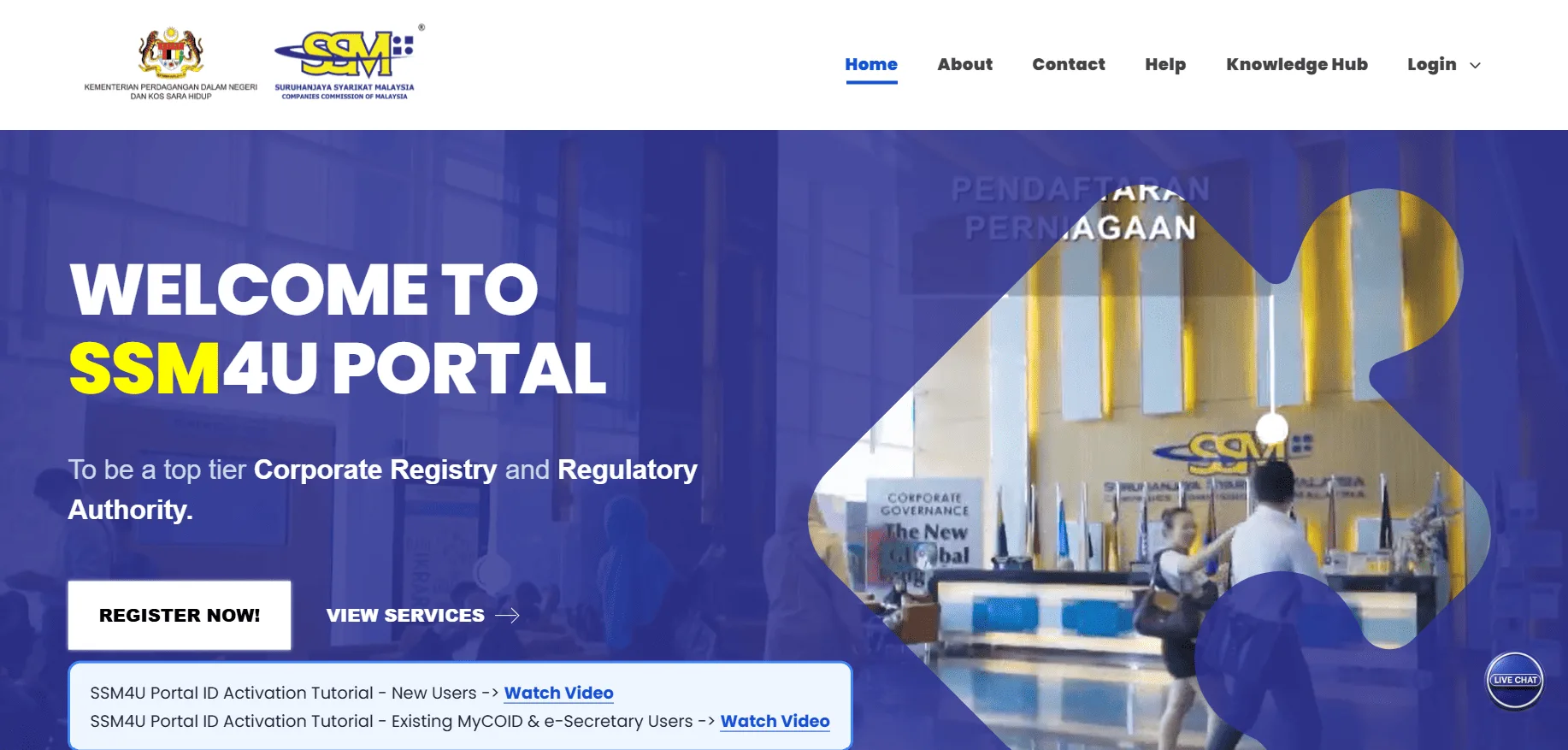
SSM and its portals are present at every step of setting up and running a company, and this section covers what they are, how their systems have changed (including the move from MyCoID to CRS) and how to look up company records.
51. What is SSM?
SSM (Suruhanjaya Syarikat Malaysia) is the government agency that registers companies, LLPs and businesses, and enforces the Companies Act 2016. Think of it as our version of ACRA or Companies House.
52. What is SSM called in English?
The Companies Commission of Malaysia (CCM).
53. What is MyCoID?
MyCoID was SSM’s online portal for incorporating companies and lodging company documents, until it was replaced by the Corporate Registry System (CRS) on SSM4U around mid-2026. Plenty of guides online still reference it, so if one tells you to register on MyCoID, it’s out of date!
54. How do I register for and log in to MyCoID?
You can’t incorporate a new company through MyCoID anymore, since it’s been replaced by CRS on SSM4U. Here’s the new route:
- Register an SSM4U account and confirm your email.
- Verify your identity at an SSM counter or Tap.it kiosk (locals), or online (foreigners).
- Go to Application > Register of Company (ROC) > Name Search > New Incorporation.
- Fill in the form and pay SSM’s RM1,010 fee.
Most business owners leave this to their Company Secretary anyway.
55. What is the difference between MyCoID and ezBiz?
MyCoID used to handle companies, while ezBiz handles sole proprietorships and partnerships, including registration and renewal. For companies, MyCoID has since been replaced by CRS on the SSM4U portal.
56. What is an SSM certificate and what does it show?
For a Sdn Bhd, people usually mean the Section 15 notice of registration, which shows the company name, registration number and incorporation date. For an enterprise, it’s the business registration certificate.
57. What does ‘SSM registered’ mean after a business name?
It means the business or company is officially registered with SSM and legally allowed to operate under that name.
58. Does registering with SSM make a business a local entity?
Yes. A company incorporated with SSM is a Malaysian company, even if it’s 100% foreign-owned.
59. How do I get a company profile or company report from SSM, and how much does it cost?
Buy it on SSM e-Info. Here’s what the most common documents cost:
| Document | Standard | Certified true copy |
| Company profile | RM15.40 | RM30.80 |
| Certificate of incorporation | RM25.40 | RM40.80 |
| Particulars of directors or shareholders | RM25.40 | RM40.80 |
| Two-year financial comparison | RM25.40 | Not available |
| Attestation of Company Good Standing | RM105.40 | Not available |
Banks and agencies usually want the certified true copy, so check which one they need before you buy.
60. How can I check who the directors and shareholders of a company are?
Buy the company’s profile from SSM e-Info for RM15.40. It shows the directors and officers with their appointment dates, every shareholder and how many shares they hold, the share capital, registered address, any company charges and a summary of the latest financial statements. That makes it a handy check before you do business with someone.
61. What is the SSM gazette?
It’s where SSM publishes official notices, such as companies it intends to strike off or has dissolved, so creditors and the public get a chance to object.
62. Is SSM the same as Companies House in the UK?
It plays a similar role as the official company register. SSM also registers sole proprietorships and partnerships and enforces company law, so it does a bit more.
63. Why does my business need to be registered with SSM?
Carrying on a business without registering is an offence. Registration also lets you open a business bank account, apply for licenses and sign contracts in the business name, so there’s really no way around it.
Superform & Section 14 (↑)

The Superform sits at the heart of every incorporation, and, these questions explain what’s in it, how it relates to Section 15, and what replaced the old forms people still mention by name.
64. What is the SSM Superform?
It’s the single online application under Section 14 of the Companies Act 2016 that combines the name application and incorporation details. It replaced the old pile of separate forms.
65. What is Section 14 of the Companies Act 2016?
Section 14 sets out how to apply to incorporate a company, including what SSM needs to know about the company, its directors, shareholders and secretary.
66. What information goes into the Superform?
The Superform asks for:
- the company name, type and business activities
- the registered office and business address
- details of each director and shareholder
- the share structure
- declarations from the promoters and directors
Your Company Secretary fills this in on CRS using the details you give them.
67. What does a completed Superform look like?
It’s a multi-page printout from SSM’s system listing the company details, directors, members and shares, plus the signed declarations. Your Company Secretary will keep a copy for you.
68. What is the difference between Section 14 and Section 15?
Section 14 is the application to incorporate. Section 15 is SSM’s notice of registration, confirming your company now exists.
69. How do I get a copy of my company’s Section 14 document?
Ask your Company Secretary, who keeps the incorporation records. If you just need the details, a current company profile from SSM e-Info shows most of the same information.
70. Why do local councils ask for the Superform in license applications?
It shows who the directors and shareholders are and what the company was set up to do, which councils use to check who’s applying.
71. What were Forms 9, 13, 24 and 49, and what replaced them?
These forms came from the old Companies Act 1965 and were replaced when the Companies Act 2016 took effect.
| Old form | What it covered | Replaced by |
| Form 9 | Certificate of incorporation | Section 15 notice of registration |
| Form 13 | Change of company name | Notice of change of name under the 2016 Act |
| Form 24 | Return of allotment of shares | Section 78 return of allotment |
| Form 49 | Register of directors, managers and secretaries | Section 58 notice of change in the register |
Banks and agencies still ask for the old forms by name surprisingly often, so it helps to know which new document to hand over.
Registration numbers (↑)
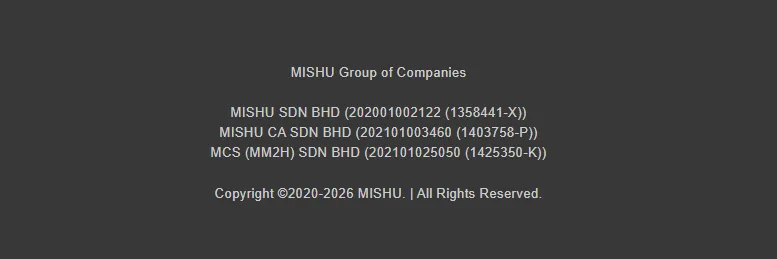
Every company has two registration numbers, which confuses people on forms and invoices more often than you’d think. Here’s how the 12-digit format works and how it differs from older numbers and tax numbers.
72. What is the 12-digit company registration number?
Since 11 October 2019, SSM gives every entity a 12-digit number. The first four digits are the registration year, the next two show the entity type (01 for a local company) and the last six are a running number.
73. What is the difference between the old and new registration numbers?
Old numbers were shorter with a check letter, like 1358441-X. The new 12-digit format covers every entity, and older companies were given one too, which is why you’ll often see both together. Our own company profile, for example, shows 202001002122 (1358441-X).
74. Does the registration number show when a company was incorporated?
Partly. The first four digits show the year of registration, but for the exact date you’ll need the Section 15 notice or the company profile.
75. Is the company registration number the same as the tax identification number?
No, and this trips up a lot of people. The registration number comes from SSM, while the tax identification number (TIN) comes from LHDN and starts with C for companies.
76. What are ROC and ROB numbers?
ROC (Registration of Companies) numbers belonged to companies, and ROB (Registration of Businesses) numbers belonged to sole proprietorships and partnerships. Both have since been replaced by the 12-digit format.
77. Where do I find a company’s registration number?
On the Section 15 notice, the company’s letterhead or invoices, or by searching the name on SSM e-Info.
Sdn Bhd costs & fees (↑)

Unsurprisingly, cost is one of the most searched topics in our data. This section separates SSM’s fixed fees from professional fees, and shows what it really costs to keep a Sdn Bhd running year after year.
78. How much does it cost to register a Sdn Bhd?
SSM’s official fee is RM1,010, and if you register yourself, that’s genuinely all you pay. Most people use a service provider though, and here’s how it typically adds up:
| Item | Cost |
| SSM incorporation fee | RM1,010 |
| Name reservation (optional) | RM50 per name |
| Incorporation through a service provider, including SSM’s fee | From RM1,888 with MISHU |
Once you add a Company Secretary, accountant, tax agent and first-year audit, the realistic first-year cost is closer to RM11,800 to RM13,300. And be wary of anyone advertising incorporation for less than SSM’s RM1,010, as hidden fees or bundled services usually follow.
79. What are SSM’s incorporation fees?
SSM’s incorporation fee depends on the type of company.
| Company type | SSM incorporation fee |
| Company limited by shares | RM1,010 |
| Company limited by guarantee | RM3,000 |
| Unlimited company | RM1,000 |
For a new Sdn Bhd, SSM’s total charge comes to RM1,010. Reserving a name is optional and costs RM50 per name for 30 days.
80. Does the amount of share capital change the SSM registration fee?
No. A Sdn Bhd pays the same flat RM1,010 whether its paid-up capital is RM1 or RM1 million.
81. What is usually included in an incorporation package price?
Packages vary, but they typically include:
- SSM fees
- the name search
- preparing and lodging the Section 14 application
- the first board resolutions
- share certificates
- sometimes the first year of Company Secretary service
It’s worth checking whether help with the bank account and a constitution are included too.
82. Is there a cheap way to open a Sdn Bhd?
SSM’s RM1,010 is fixed, so there’s no getting around that. You can save on professional fees by keeping your paid-up capital low (in practice RM2,500, since that’s what banks usually look for) and skipping extras like a custom constitution, but you’ll still need a Company Secretary within 30 days.
83. How much does it cost a foreigner to open a company?
SSM’s fees are the same RM1,010. Foreign-owned set-ups usually cost more in professional fees because of document verification, and you may need higher paid-up capital if you plan to hire foreign staff or need a license.
84. What does it cost each year to maintain a Sdn Bhd?
Here’s what a typical small Sdn Bhd pays each year, based on what we see in the market:
| Item | Typical yearly cost |
| SSM annual return | RM150 |
| Lodging financial statements with SSM | RM50 |
| Company Secretary | From RM2,400 (RM200 a month) |
| Accounting | Around RM5,000 |
| Tax agent | RM1,000 to RM1,500 |
| Audit (unless exempt) | RM1,500 to RM2,500 in the first year |
Realistically, budget at least RM10,000 a year. In the first year, adding incorporation brings the total to around RM11,800 to RM13,300.
85. How much are Company Secretary fees each year?
Plans are usually priced by how many changes and resolutions you expect. For context, ours starts at RM200 a month (RM2,400 a year) and covers basic resolutions, with non-standard ones charged separately. If your company changes often, a premium plan usually works out cheaper.
86. How much does accounting and bookkeeping cost for a Sdn Bhd?
It depends on how many transactions you have, but around RM5,000 a year is typical for a small company. Tax filing is often a separate service at RM1,000 to RM1,500 a year, even when the same firm handles both.
87. How much does a company audit cost?
Expect around RM1,500 to RM2,500 for a first-year audit, rising with transaction volume and complexity. Most new companies can’t use audit exemption straight away (see the audit question further down), and if you ever switch auditors, SSM charges RM500 to file the change.
88. What is the SSM fee for filing an annual return?
RM150 for a private company (Sdn Bhd) and RM500 for a public company (Bhd), as long as you file on time. Lodging your audited financial statements costs another RM50, and applying for extra time to lodge them costs RM100. Skipping any of these isn’t an option, since the late penalties cost far more.
Share capital & paid-up capital (↑)

For new entrepreneurs, paid-up capital might be the most misunderstood part of registering a company, and plenty of people still believe they need a big sum in the bank to start.
These questions explain the real legal minimum, what banks expect in practice, and when you’ll need more for passes, licenses and contractor grades.
89. What is the difference between share capital and paid-up capital?
Share capital is the value of shares the company has issued, and paid-up capital is the part shareholders have actually paid for. Since the Companies Act 2016 removed par value and authorised capital, the two are usually the same in practice.
90. What is the minimum paid-up capital for a Sdn Bhd?
RM1. Yes, really, although banks usually want to see more, as the next answer explains.
91. Why do so many companies have RM1 paid-up capital?
Because RM1 is the legal minimum and costs nothing extra. That said, in our experience banks usually want to see at least RM2,500 before approving a company account, so we treat that as the practical minimum to actually do business. Owners often top it up further once they know what their licenses, financing or work passes call for.
92. Do subscribed shares have to be paid for, and by when?
Shares can be issued unpaid or partly paid, and shareholders owe the balance when the company calls for it. Most small companies keep things simple and issue fully paid shares from the start.
93. Do I need RM250,000 in the bank to open a Sdn Bhd?
No. You can incorporate with RM1. Figures like RM250,000 come from the Employment Pass rules for locally owned companies that want to hire foreign staff, which is a separate matter entirely.
94. How much paid-up capital do I need for visa or license applications?
To sponsor Employment Passes, Immigration generally expects the following paid-up capital.
| Company ownership | Paid-up capital |
| Locally owned | RM250,000 |
| Joint venture | RM350,000 |
| 100% foreign-owned | RM500,000 |
Joint venture here means at least 30% foreign equity. Companies more than 50% foreign-owned will usually also need a WRT or USS license, which requires RM1 million paid-up capital, so that tends to become the real figure.
95. What is the minimum paid-up capital for a foreign-owned company?
There’s no special minimum just to incorporate, but in practice most foreign-owned companies need far more – if the company is more than 50% foreign-owned and sells goods or services, it will need a WRT or USS license, which requires at least RM1 million paid-up capital.
Separately, Immigration expects RM500,000 before a 100% foreign-owned company can sponsor Employment Passes.
96. How much paid-up capital does a Berhad need?
The Companies Act doesn’t set one for a public company. Listing on Bursa Malaysia is a different story, with much higher requirements.
97. Can paid-up capital be injected in a foreign currency?
Foreign shareholders can remit funds from abroad into the company’s bank account, and the shares are recorded at the ringgit value. Check with your bank first, as each has its own paperwork for this.
98. How do I increase my company’s paid-up capital?
Pass a resolution to issue new shares, collect payment from the shareholders, then lodge a return of allotment under Section 78 with SSM within 14 days.
99. How does paid-up capital affect a company’s CIDB grade?
Each CIDB grade sets both a minimum paid-up capital and the maximum project value you can take on:
| Grade | Minimum paid-up capital | Maximum project value (building, civil, mechanical) |
| G1 | RM5,000 (RM10,000 for SPKK) | Up to RM200,000 |
| G2 | RM25,000 | Up to RM500,000 |
| G3 | RM50,000 | Up to RM1 million |
| G4 | RM150,000 | Up to RM3 million |
| G5 | RM250,000 | Up to RM5 million |
| G6 | RM500,000 | Up to RM10 million |
| G7 | RM750,000 | No upper limit |
Higher grades also need more qualified technical staff, so set your capital with your target grade in mind. You can always move up, or down, later.
100. Does Malaysia Digital (MSC) status require a minimum share capital?
Barely. To keep MD status, you only need paid-up capital of RM1,000. The bigger asks come within 12 months of approval, when you must:
- have started operating your MD activities
- employ at least two full-time knowledge workers on an average of RM5,000 a month
- spend at least RM50,000 a year on your MD activities
If you later want the MD Expansion Incentive though, you’ll need at least RM250,000 paid-up capital and three years of operation.
Directors (↑)

This section covers what company directors do, when they can be personally on the hook, and practical questions on appointments, pay and contributions.
101. What are a director’s roles and responsibilities?
Directors manage the company’s business. Their main duties are to:
- act in good faith in the company’s best interests
- use reasonable care and diligence
- avoid conflicts of interest
- make sure statutory filings and records are kept
Breach them and a director can end up personally liable, so it pays to take them seriously.
102. Is a director personally liable for the company’s debts?
Not normally, because the company is its own legal person. Where directors do get caught out is personal guarantees, fraudulent or reckless trading, and breaches of their duties. Bank loans for new companies often come with a personal guarantee, so read the fine print.
103. Can creditors collect a Sdn Bhd’s debt from its directors?
Only in limited cases, such as where a director signed a personal guarantee, or the court finds fraudulent trading or debts run up with no reasonable expectation of paying them back. Otherwise, creditors have to go after the company itself.
104. How do I appoint a director?
The board or shareholders pass a resolution, the new director signs a consent to act and declares they’re not disqualified, and your Company Secretary notifies SSM within 14 days.
105. How do I remove a director?
In a private company, shareholders can remove a director by ordinary resolution, subject to the constitution and the director’s right to be heard. SSM then needs to be notified within 14 days.
106. What is the difference between an executive and a non-executive director?
An executive director works in the business day to day, usually as an employee. A non-executive director sits on the board to oversee and advise without a management role.
107. What do the DO and DS designations mean on SSM records?
They flag people holding two roles at once. DO typically means someone who’s both a director and an officer, such as the Company Secretary, while DS typically means someone who’s both a director and a shareholder. These codes usually turn up in older documents or third-party search reports, since current SSM company profiles spell designations out in full, such as ‘Director’ or ‘Secretary’. If you’re unsure about one on your records, your Company Secretary can confirm it.
108. Is a CEO or company manager the same as a director?
No. CEO or manager is an employee title, while a director is an officer registered with SSM with legal duties. One person can wear both hats though.
109. Must the CEO of a Malaysian company be Malaysian?
If this was the case every MNC in Malaysia would get shut down overnight!
Your CEO can be any nationality, but a foreigner working in Malaysia needs a valid work pass, and the company still needs one director who ordinarily resides here.
110. Can an employee become a director?
Yes. An employee can be appointed as a director at any time and keep their job.
111. Should a director take director’s fees or a salary?
Both are taxed as your personal income and deductible for the company, but they work quite differently:
| Salary | Director’s fees | |
| EPF, SOCSO and EIS | Yes (EPF is 11% from you and 12% from the company) | No |
| Monthly payroll | Yes | No |
| Approval needed | No | Shareholder approval |
| Main upside | Forced retirement savings, EPF tax relief, easier loan approvals | Cheaper for the company, full control over the cash |
As a rule of thumb, take a salary if you’d rather the system plan your retirement, and fees if you trust yourself to put the money to better use.
112. Do directors have to contribute to EPF and SOCSO?
It depends on how you’re paid and whether you actually work in the business:
- executive directors drawing a monthly salary under an employment contract must contribute to EPF, SOCSO and EIS, alongside the company
- non-executive directors who only attend board meetings and don’t draw a salary don’t need SOCSO
- dividends and director’s fees don’t attract EPF or SOCSO at all
Owner-directors who don’t fit the standard employee definition can still opt into PERKESO’s Self-Employment Social Security Scheme (SKSPS) voluntarily, which is worth considering if you’d like the cover.
113. How is money a director lends to or owes the company recorded?
Money a director lends the company is recorded as ‘amount owing to director’, a liability. Money a director takes out is ‘amount owing by director’, an asset. Be careful with the second one, as companies are generally restricted from lending to their own directors.
Nominees (↑)

Nominee arrangements come up with foreign-owned companies that need a resident director. We’ve included these questions to explain how nominee roles work and the risks involved, but they’re for information only, as MISHU no longer provides this service.
114. What is a nominee director?
Someone appointed to the board on behalf of another person, most often to meet the resident director requirement for a foreign-owned company.
115. Is a nominee director arrangement legal in Malaysia?
Yes, but a nominee director carries exactly the same legal duties and liabilities as any other director. They must act in the company’s best interests, not just follow instructions.
116. Can a nominee director sign contracts and resolutions?
Legally, yes. In practice the nominee agreement usually limits what they’ll sign, and many nominees will only touch statutory documents.
117. What are the risks of being a local nominee director for a foreign-owned company?
The nominee can be held personally liable for breaches, missed filings or misconduct they had no control over, and fines from SSM, LHDN or other agencies can land on directors in default. It’s a big part of why MISHU no longer provides this service.
118. Can a company operate without a nominee director?
Yes, as long as at least one actual director ordinarily resides in Malaysia, such as a foreign owner living here on an Employment Pass.
119. What should a nominee director agreement include?
A nominee director agreement should cover:
- the scope of the role
- fees
- indemnities
- the documents the nominee will and will not sign
- access to company information
- how the appointment ends
Have a lawyer look over the agreement before anyone signs.
120. What is a nominee shareholder, and is it legal?
A nominee shareholder holds shares on behalf of someone else, the beneficial owner. It’s legal, but the beneficial owner still has to be disclosed to the company and reported to SSM.
121. What is a share proxy agreement?
It’s a private agreement where the registered shareholder holds shares for another person. These can’t be used to get around foreign ownership rules, and the beneficial owner still has to be disclosed.
Shareholders & beneficial owners (↑)

Shareholders own the company, but their rights and risks are quite different from directors’. This section also covers beneficial ownership, which every company now has to record and report to SSM.
122. What is the difference between a shareholder and an investor?
A shareholder is anyone registered as owning shares. An investor is anyone who puts money into the company, whether through shares, loans or something else.
123. What are a shareholder’s rights and duties?
Shareholders can vote at meetings, receive any dividends declared, inspect certain records, and appoint or remove directors. Their main duty is simply to pay for their shares.
124. Is a shareholder liable for the company’s debts?
No. A shareholder’s liability stops at any amount unpaid on their shares.
125. Can a company have a single shareholder?
Yes. A Sdn Bhd can have just one shareholder.
126. Can another company or an LLP be a shareholder in a Sdn Bhd?
Yes. Local and foreign companies, as well as LLPs, can all hold shares in a Sdn Bhd. Plenty of Singaporean owners hold theirs through their Pte Ltd, for example.
127. How do I sell or transfer shares in a private company?
The seller and buyer sign an instrument of transfer, stamp duty of 0.3% of the higher of price or value is paid, the directors approve the transfer if the constitution requires it, and your Company Secretary updates the register of members.
128. What happens at a shareholders’ meeting?
Shareholders vote on things like appointing directors, approving accounts, declaring dividends or changing the constitution. Private companies can pass most of these in writing instead, so plenty of Sdn Bhds rarely meet at all.
129. What is a beneficial owner?
The individual who ultimately owns or controls a company, generally anyone holding 20% or more of the shares or voting rights, or exercising control in other ways.
130. What is the beneficial ownership register, and what are the penalties for not keeping one?
Every company has to keep a register of its beneficial owners, lodge the information with SSM and update it whenever anything changes. Get it wrong and SSM will usually start with an administrative compound of RM1,000 to RM3,000, before escalating to court prosecution if it still isn’t fixed.
Company Secretaries 🤓

Every Sdn Bhd must appoint a Company Secretary within 30 days of incorporation, and this section addresses questions we’ve answered at least 10 billion times before – what the role involves, who can do it and how to switch.
131. Does every Sdn Bhd need a Company Secretary?
Yes. Every company must appoint at least one.
132. When must a Company Secretary be appointed, and what happens if you don’t?
Within 30 days of incorporation, and again within 30 days if your secretary resigns or is removed. Missing either deadline is a criminal offence: the company and its directors can face fines of up to RM50,000, up to three years in prison, or both, plus daily default penalties. Unsurprisingly, it’s one of the first things we sort out!
133. What does a Company Secretary do?
A Company Secretary’s main tasks are to:
- keep the statutory registers
- prepare resolutions and minutes
- lodge annual returns and notices with SSM
- advise the board on compliance with the Companies Act 2016
As an officer of the company, the secretary can also be held responsible for filing failures, which is why the good ones chase you for documents!
134. What criteria should you consider when appointing a Company Secretary?
They must be at least 18, ordinarily reside in Malaysia, and either belong to a prescribed professional body or hold an SSM practising certificate. Beyond that, look at how responsive they are, what they charge and how they handle your documents.
135. How do I change or remove my Company Secretary?
The board passes a resolution appointing the new secretary and accepting the old one’s resignation or removal. SSM is notified within 14 days, and the records pass to the new secretary.
136. What documents does a Company Secretary keep for the company?
Your Company Secretary usually keeps:
- the registers of members, directors and beneficial owners
- minutes and resolutions
- the constitution
- share certificates
- copies of SSM lodgements
You’re entitled to copies of these records at any time, so don’t be shy about asking.
137. How much do Company Secretaries charge for resolutions and dividend declarations?
Most charge per resolution on top of the annual retainer, commonly in the low hundreds of ringgit each. Check the fee schedule before you sign up, not after.
138. What is a digital or e-secretary service?
A Company Secretary service that runs online, with e-signatures, cloud storage of records and online requests instead of paper and office visits. MISHU actually started out as one back in 2020.
139. What should I ask a new Company Secretary before switching?
Ask about their qualifications, annual fees and extra charges, how they’ll take over your records from the old secretary, and how quickly they turn around resolutions and filings.
Foreign ownership (↑)

Foreign founders ask some of the most specific questions in our search data, and for good reason. Registering is the easy part, and running the business is where the real requirements kick in. This section covers ownership limits, residency rules, Bumiputera myths and the passes foreign owners need to work in their own company.
140. Can a foreigner register a company in Malaysia?
Yes. Foreigners, whether Singaporean, Canadian or from anywhere else, can incorporate a Sdn Bhd as shareholders and directors, as long as at least one director ordinarily resides in Malaysia. Registering is the easy part though. It’s running the business that comes with the real requirements.
141. Can a foreigner own 100% of a Sdn Bhd?
Yes, in most sectors, but it comes at a price. A company more than 50% foreign-owned in trade or services generally needs a WRT or USS license, which requires RM1 million paid-up capital. In our experience, the main way around this is entering through MDEC’s Malaysia Tech Entrepreneur Programme (MTEP), but that’s limited to approved tech verticals. Some activities, such as certain distributive trade, telecommunications and energy, also have outright foreign ownership limits.
142. Can a foreign-owned company have only foreign directors?
Yes, as long as at least one of them ordinarily resides in Malaysia, for example a foreign director living here on an Employment Pass.
143. Does a foreigner need a Malaysian partner to start a business?
Not for most businesses. You only need one in sectors with foreign equity limits, or where a license requires local participation. That said, some foreign owners bring in a Malaysian partner with at least 51% to avoid the RM1 million WRT or USS license requirement. It works, but it also means you no longer control the company, so choose that partner very carefully.
144. Do Malaysian companies have to be majority owned by Malaysians or Bumiputera?
No, there’s no general rule. Bumiputera equity conditions only apply in specific cases, such as some government contracts, some licenses and certain sectors.
145. Which business activities restrict foreign ownership?
Foreign ownership restrictions mainly apply to:
- certain distributive trade, such as convenience stores and petrol stations
- telecommunications
- energy
- financial services
- legal services
- some licensed professions
Most other sectors allow 100% foreign ownership, though licenses like WRT may still apply.
146. What are the distributive trade guidelines for foreign-owned companies?
KPDN treats any foreign-owned business that channels goods to end customers as distributive trade, which covers F&B outlets, retail stores and foreign franchises, among others. These businesses need a WRT license and at least RM1 million paid-up capital, and approval comes easier if you can show you’ll fill a market gap, offer something unique or transfer skills to Malaysians, rather than compete head-on with local businesses. That’s by design, since the license exists partly to protect local SMEs.
147. Can a foreign-owned company run a supermarket, convenience store or F&B outlet?
Convenience stores are generally reserved for Malaysians. Bigger formats are open to foreigners but heavily regulated: hypermarkets (5,000 sqm and up) and superstores need RM20 million to RM50 million paid-up capital, a share of products from local Bumiputera SMEs and a feasibility study involving local retailers and residents. Foreign-owned restaurants are possible with a WRT license and RM1 million paid-up capital, and KPDN will want to see your menu, your chef’s credentials and a cuisine that doesn’t compete directly with local food businesses.
148. What is the difference between a majority and minority foreign-owned Sdn Bhd?
Above 50% foreign ownership, the company generally needs a WRT or USS license with RM1 million paid-up capital, and more paid-up capital to sponsor Employment Passes. And once more than 20% is foreign-owned, the company loses the 15% and 17% SME tax rates and pays 24% across the board.
149. Can a non-resident without a Malaysian address be a shareholder?
Yes. Shareholders can live anywhere and simply use their overseas address.
150. Can a foreigner set up a company without coming to Malaysia?
Yes. Documents can usually be signed and verified remotely through your Company Secretary. You’ll still need a director who ordinarily resides in Malaysia though, and banks may ask you to come in person.
151. How long does it take to set up a foreign-owned company?
Incorporation itself can take just a few days. Allow two to four weeks with document verification and bank account opening, and longer if licenses or Employment Passes are involved.
152. Which pass does a foreign owner need to work in their own company, and is an Employment Pass required?
If you’ll be working in Malaysia, generally yes. Your company sponsors you for an Employment Pass, and the category depends on your salary:
| Category | Minimum monthly salary | Validity | Typical roles |
| 1 | RM20,000 | 10 years | Directors, C-suite, senior management |
| 2 | RM10,000 | 10 years | Managers and specialists |
| 3 | RM5,000 (RM7,000 for manufacturing) | 5 years | Technical specialists, junior executives |
A company’s first application usually takes around six months, and Immigration charges RM2,000 plus RM200 for each year of validity.
Tech founders in approved verticals like fintech, AI or cleantech can go through MDEC’s MTEP instead. New founders get a renewable one-year Professional Visit Pass, while those with two years’ track record and USD100,000 raised can get a five-year Resident Pass that covers dependants. Either way, you’ll need RM50,000 sitting in a personal current or savings account for three months. And if you’re a shareholder or director who lives abroad and doesn’t work here, you don’t need a pass at all.
153. Can an MM2H holder own a company or be a director?
It depends on the tier. Platinum MM2H holders are allowed to work and do business in Malaysia, so running your own company is fine. Gold and Silver holders can invest and hold shares, but can’t work or do business here, so an active role would need a separate work pass.
154. Can the foreign spouse of a Malaysian start a business?
Yes. They can own shares in a Sdn Bhd. To work in the business, they’ll need a pass that allows it, such as a Long-Term Social Visit Pass with work endorsement.
Foreign companies, subsidiaries & branches (↑)

Not every foreign business needs a brand new Sdn Bhd. These questions compare subsidiaries, branches and representative offices, and explain when a foreign company has to register in Malaysia.
155. Should a foreign company set up a subsidiary, a branch or a representative office?
Each option suits a different level of commitment.
| Subsidiary (Sdn Bhd) | Branch | Representative office | |
| Legal status | Separate local company | Part of the foreign company | Not a separate entity |
| Liability | Limited to the subsidiary | The foreign parent is liable | The foreign parent is liable |
| Can it trade? | Yes | Yes | No, only market research and liaison |
For most foreign companies, a subsidiary is the better choice and the one we see chosen most often. Tax isn’t a deciding factor, since both pay a flat 24%, and with majority shareholding and board seats the parent still keeps plenty of control while staying protected from the subsidiary’s debts.
156. How does a foreign company register with SSM?
A foreign company that wants to operate through a branch registers with SSM under the Companies Act 2016, lodging its constitution, certificate of incorporation and director details, and appointing a local agent who ordinarily resides in Malaysia. SSM’s fee depends on the parent’s share capital:
| Parent’s share capital | SSM registration fee |
| Up to RM1 million | RM5,000 |
| RM1 million to RM10 million | RM20,000 |
| RM10 million to RM50 million | RM40,000 |
| RM50 million to RM100 million | RM60,000 |
| Above RM100 million | RM70,000 |
After that, the branch files the parent’s financial statements with SSM every year and reports any changes to the parent’s structure.
157. What documents does a foreign corporate shareholder need to provide?
Usually its certificate of incorporation, constitution, register of directors, and a board resolution approving the investment and appointing a representative. All of it needs to be certified, and translated into English where needed.
158. What counts as a foreign company under the Companies Act 2016?
A company or body corporate incorporated outside Malaysia. A Sdn Bhd owned by foreigners is still a local company, not a foreign one.
159. Can a foreign company do business in Malaysia without registering?
Not if it’s carrying on business here, which means registering as a foreign company or setting up a local subsidiary. Isolated transactions and selling into Malaysia from abroad are treated differently.
160. Does a foreign company need a Malaysian entity to hire employees?
Generally yes, so it can register as an employer with EPF and SOCSO. Some companies use an employer of record service instead.
161. Do foreign online marketplaces need to register a business in Malaysia?
Not necessarily. Foreign digital service providers selling more than RM500,000 a year to Malaysian consumers must register for service tax on digital services, but that doesn’t require a local company.
162. Can a branch of a foreign company open a Malaysian bank account?
Yes, once it’s registered with SSM. Banks will want the foreign company’s documents along with the SSM registration.
163. How do I set up a joint venture company?
Incorporate a Sdn Bhd with the partners as shareholders in the agreed proportions, and sign a shareholders’ agreement covering control, funding, profit sharing and exit. Please don’t skip that last part!
164. Can a Malaysian company be based outside Malaysia?
It must keep a registered office in Malaysia and at least one director who ordinarily resides here. Its owners and operations can be overseas.
Labuan companies (↑)

Labuan companies run on a completely separate regime from Sdn Bhds, but people often weigh one against the other. We’ve included this section so you can see how Labuan entities work, and why a Sdn Bhd is usually the better fit if you’re selling to Malaysians.
165. What is a Labuan company?
A company incorporated in the Labuan International Business and Financial Centre under the Labuan Companies Act 1990, and regulated by the Labuan Financial Services Authority (Labuan FSA). It’s built mainly for international business.
166. Is a Labuan company an offshore company, and is Labuan a tax haven?
Labuan is Malaysia’s midshore financial centre. Taxes are low, but it’s not a secrecy jurisdiction: Labuan entities have to meet substance requirements and follow international tax transparency standards.
167. What is the difference between a Labuan company and a Sdn Bhd?
A Labuan company is built for international business, generally deals in foreign currency and pays Labuan tax. A Sdn Bhd can trade freely within Malaysia in ringgit and pays normal Malaysian corporate tax. If your goal is selling to Malaysian customers, a Labuan company isn’t the right tool.
168. How do I register a Labuan company?
You have to go through a licensed Labuan trust company, which provides your Company Secretary and registered office, runs due diligence and advises you on any licenses. Reserving a name costs USD15 (about RM50), is usually approved within 24 hours and is held for three months, and the trust company handles the rest of the incorporation with Labuan FSA.
169. How much does it cost to set up a Labuan company?
Labuan FSA’s official fees depend on the type of company and its paid-up capital:
| Company | Registration fee | Annual fee |
| Labuan company, paid-up up to RM50,000 | RM1,000 | RM2,600 |
| Labuan company, paid-up RM50,001 to RM1 million | RM2,000 | RM2,600 |
| Labuan company, paid-up above RM1 million | RM5,000 | RM2,600 |
| Foreign Labuan company | RM6,000 | RM5,300 |
Trust company fees come on top and vary a lot between providers, so it’s worth getting a few quotes.
170. What tax does a Labuan company pay?
A Labuan trading company pays 3% on net audited profits, provided it meets substance requirements: a physical office in Labuan, enough full-time staff based there and a minimum level of spending in Labuan. A Labuan company with only non-trading activities, such as holding investments, generally pays no tax on that income. Audited financial statements go to Labuan FSA within nine months of the financial year end.
171. What is a Labuan pure equity holding company?
A Labuan company that only holds shares in other companies and earns dividends and gains. It has lighter substance requirements than a trading company.
172. What counts as an equity investment for a Labuan company?
Shares and similar equity interests in other companies. Loans, property and other assets don’t count.
173. Does a Labuan company need a resident director?
No resident director is needed, but it must have a resident secretary and registered office through a Labuan trust company.
174. How do I get a Labuan director visa, and do I need to be there in person?
Your Labuan company applies for an Employment Pass on your behalf, which needs joint approval from Labuan FSA and Immigration. It usually takes 45 to 60 days and costs USD350 to process, and you’ll usually need to be in Malaysia to have the pass endorsed.
175. Can a Labuan work permit holder work from Kuala Lumpur?
Only if it’s a Labuan holding company with Labuan FSA approval for an operational and management office in Kuala Lumpur. Approval costs RM1,000 to process plus RM10,000 a year, and the company must:
- have international or regional operations
- deal mainly with non-residents, in foreign currency
- run a separate office with its own staff, its own books and a signboard saying ‘Labuan Company’
- elect to be taxed under the Income Tax Act 1967, giving up Labuan’s 3% rate
Expatriates working in the KL office still need work permits from Immigration.
176. How do I change a Labuan company’s name, and what does it cost?
Your trust company files the change of name with Labuan FSA once a resolution is passed. Labuan FSA charges a fee, and the trust company adds its own on top.
177. Can a Labuan company be converted into a Sdn Bhd?
No. Labuan companies and Sdn Bhds sit under two separate legal frameworks and regulators, so there’s no direct conversion. Instead, you incorporate a new Sdn Bhd, transfer the assets and business across properly, then strike off the Labuan company through your Labuan trust company.
178. How do I strike off a Labuan company?
Your Labuan trust company applies to Labuan FSA once the company has stopped operating, settled its liabilities and paid any outstanding fees.
179. Can a Labuan company be used for e-commerce?
For international customers, yes. Selling to Malaysian customers in ringgit is restricted though, so for the local market a Sdn Bhd is usually the better fit.
Sole proprietorships & enterprises (↑)

Plenty of Sdn Bhds start life as enterprises, and plenty of enterprise owners are wondering when to upgrade. This section covers how enterprises are registered and taxed, and how to move the business into a Sdn Bhd when the time comes.
180. What is a sole proprietorship?
A business owned by one person and registered with SSM under the Registration of Businesses Act 1956. Legally, the owner and the business are the same person, debts included.
181. What does ‘enterprise’ mean in a Malaysian business name?
It’s simply a popular word in the trade names of sole proprietorships and partnerships, as in ‘ABC Enterprise’. It doesn’t mean the business is a company.
182. How do I register an enterprise with SSM?
Register online through SSM’s ezBiz portal. It costs RM60 a year for a trade name, or RM30 a year if you use your own name as it appears on your IC.
183. Can a foreigner own an enterprise?
No. Only Malaysian citizens and permanent residents can register a sole proprietorship or partnership, so foreigners need a Sdn Bhd or an LLP.
184. How is a sole proprietor’s income taxed?
Business profit is added to the owner’s other income and taxed at personal rates from 0% to 30%, filed on Form B.
185. What expenses can a sole proprietor claim?
Anything wholly and exclusively spent to earn business income, such as rent, staff wages, stock, utilities and marketing. Capital items get capital allowances instead, and personal drawings aren’t deductible, however tempting.
186. When is the tax filing deadline for a sole proprietor?
Form B is due on 30 June of the following year, with a short grace period if you e-file.
187. Can a sole proprietor pay themselves a salary or EPF?
Paying yourself counts as drawings, not deductible salary. You can, however, make voluntary EPF contributions as a self-employed person.
188. Does a sole proprietor need a separate tax number for the business?
No. The business is taxed under the owner’s individual tax number.
189. Does an enterprise need its own business bank account?
It’s not legally required, but a separate business account makes your records and tax filing far easier, and most banks offer one for registered enterprises.
190. What accounting records must a sole proprietor keep?
Records of all income and expenses with receipts and invoices, bank statements and any assets you buy. LHDN expects you to keep them for seven years.
191. Can I add a partner or nominee to an existing enterprise?
You can add a partner, which turns the sole proprietorship into a partnership. Update the registration through ezBiz, and remember that every partner becomes personally liable.
192. How do I convert an enterprise into a Sdn Bhd?
There’s no direct conversion. You incorporate a new Sdn Bhd, move the business, assets, contracts and staff across, then terminate the enterprise registration.
193. How do I transfer assets from an enterprise to a Sdn Bhd?
The owner sells or transfers the assets to the company under a written agreement, usually at market value. The company records them as assets, with the payment either owed to the owner or settled through shares.
194. What happens to foreign worker permits when an enterprise becomes a Sdn Bhd?
Work permits are tied to the employer, so the new company generally needs its own approvals to employ the workers. Check with the Immigration Department before you move anyone across.
LLPs & partnerships (↑)

LLPs are the main alternative to a Sdn Bhd if you want limited liability without as much compliance. We’ve included them because people regularly compare the two and ask how to convert from one to the other.
195. What is an LLP (PLT) in Malaysia?
A Limited Liability Partnership (Perkongsian Liabiliti Terhad) is a separate legal entity under the Limited Liability Partnerships Act 2012. It combines the flexibility of a partnership with limited liability.
196. How do I register an LLP on MyLLP?
Create an account on SSM’s MyLLP portal, apply for the name, enter the partners’ and compliance officer’s details and pay the RM500 registration fee.
197. What supporting documents do I need to register an LLP?
IC or passport copies for each partner and the compliance officer, their addresses and contact details, and the business address. Corporate partners also need their incorporation documents.
198. Can foreigners register or be partners in an LLP?
Yes, foreigners can be partners. The catch is that the LLP’s compliance officer must be a Malaysian citizen or permanent resident who ordinarily resides in Malaysia.
199. Who can be an LLP’s compliance officer?
A partner, or someone qualified to be a Company Secretary, who’s a Malaysian citizen or permanent resident and ordinarily resides in Malaysia.
200. Does an LLP need a Company Secretary?
No. The compliance officer handles the LLP’s filings instead.
201. Do I need to submit the LLP agreement to SSM?
No. The LLP agreement stays private between the partners and doesn’t need to be lodged with SSM. You should still have one though.
202. How is an LLP taxed?
The LLP is taxed as an entity, not the partners. Qualifying SME LLPs pay 15% on the first RM150,000, 17% on the next RM450,000 and 24% above that, and profit shared out to partners isn’t taxed again.
203. What are an LLP’s annual declaration and tax deadlines?
An LLP lodges an annual declaration with SSM each year, with a RM200 fee, and files its tax return (Form PT) within seven months of its financial year end.
204. How soon after registering an LLP can I start trading?
From the registration date, once your bank account and any licenses your business needs are in place.
205. How do I convert an LLP into a Sdn Bhd?
There’s no direct conversion. You incorporate a Sdn Bhd, move the business into it, then dissolve the LLP.
206. How do I convert a Sdn Bhd into an LLP, and what does it cost?
Yes, under Section 30 of the Limited Liability Partnerships Act 2012. Every shareholder has to become a partner, nobody new can join as part of the conversion, and the company must be solvent and able to pay its debts as they fall due. SSM charges a conversion fee, and professional fees for the paperwork come on top.
207. What is a conventional partnership, and how is it taxed?
A business owned by two to 20 partners under the Partnership Act 1961. The partnership files Form P, and each partner pays personal tax on their share of the profit.
208. Can you set up a limited partnership in Malaysia?
Not onshore under general law. Limited partnerships are only available in Labuan, under the Labuan Limited Partnerships and Limited Liability Partnerships Act 2010.
209. What should a partnership agreement include?
A partnership agreement should cover:
- each partner’s capital contribution
- how profit and loss are split
- roles and decision-making
- salaries or drawings
- admitting and removing partners
- dispute resolution
- what happens when a partner leaves or dies
Without one, the Partnership Act 1961 fills in the gaps, and its defaults may not suit your arrangement at all.
MSIC codes & nature of business (↑)

MSIC codes are, by a long way, the most searched topic in our data, since every company has to declare them to SSM and LHDN.
This section explains how the codes work and points you to the right code groups for common businesses, and you’ll find every code in our full list of MSIC 2008 codes.
210. What is an MSIC code?
MSIC stands for Malaysia Standard Industrial Classification. It’s a five-digit code from the Department of Statistics (DOSM) that classifies a business activity, and both SSM and LHDN use it to record what your company does. Judging by our search data, it’s also the most asked-about topic in this entire guide!
211. Where can I find the official MSIC code list?
DOSM publishes the official MSIC 2008 classification, and LHDN publishes its own MSIC code list for tax and e-invoicing. Both are free online, but they’re not exactly light reading, so we’ve put together a more user-friendly full list of MSIC 2008 codes.
212. How do I choose the right MSIC code?
Start with the section that matches your main activity, then narrow down to the most specific five-digit code that describes what you actually sell or do.
213. How many MSIC codes can a company register?
Up to three, along with a short description of what your business does (around 200 words). Pick the codes that match what you actually do, with your main activity first.
214. Which MSIC code do I use if my company does several activities?
Put your main income-generating activity first and add the others as secondary codes.
215. How do I check which MSIC code my company is registered under?
Check your company profile on SSM e-Info, or just ask your Company Secretary.
216. Is the MSIC code for LHDN the same as the one registered with SSM?
Both use the MSIC system, but LHDN asks you to state your code separately on tax returns and e-invoices. Make sure both match your actual business.
217. What is the difference between an MSIC code and a business activity description?
The code is the standard classification. The business activity description is your own wording of what the company does, and it can be a lot more specific than the code.
218. What does ‘n.e.c.’ mean in an MSIC description?
It means ‘not elsewhere classified’, the catch-all code for activities that don’t fit anywhere more specific.
219. Can I add or change my company’s MSIC code?
Yes. Your Company Secretary can lodge the change of business activity with SSM, and you should update your details with LHDN too.
220. How do I look up what a specific code, like 46696 or 43909, covers?
Search for it in our full list of MSIC 2008 codes, which gives the description for every code, or in DOSM’s or LHDN’s official lists.
221. Which MSIC code should a trading company use?
General traders usually fall under the wholesale codes in Division 46, such as 46900 for non-specialised wholesale. If you trade one type of product, there’s likely a more specific code for it.
222. Which MSIC code covers construction and renovation work?
Building construction sits in Division 41, such as 41001 for residential buildings. Renovation and fit-out work usually falls in group 433 for building completion and finishing, and 43909 covers other specialised construction not elsewhere classified.
223. Which MSIC code covers restaurants, cafes and other F&B businesses?
Food and beverage service falls under Division 56, with 56101 for restaurants and other codes in group 561 for cafes, food stalls and similar outlets.
224. Which MSIC code should a home baker use?
Baking bread, cakes and pastries falls under class 1071 for bakery products. If you mainly resell baked goods rather than bake them, use a retail code instead.
225. Which MSIC codes cover retail shops?
Retail sits in Division 47, with specific codes for clothing, furniture, groceries and most other goods sold in shops.
226. Which MSIC code covers e-commerce?
Selling goods online to consumers usually falls under the internet retail codes in group 479. If you also sell on platforms, use the code that matches what you sell.
227. Which MSIC code covers digital marketing and consultancy?
Advertising and digital marketing fall under 73100 for advertising, while business consultancy sits in group 702 for management consultancy.
228. Which MSIC code covers training and tuition?
Tuition and training fall under Division 85 for education, mostly in group 854 for other education such as tuition centres and skills training.
229. Which MSIC code covers travel agencies?
79110 for travel agencies and 79120 for tour operators. Nice and simple, for once!
230. Which MSIC code covers clinics and medical services?
Clinics and medical practices fall under group 862, which covers general medical, specialist and dental practices.
231. Which MSIC code covers property development and real estate?
Developing and building property usually falls under Division 41 for building construction. Renting and dealing in your own property, and real estate agency work, fall under Division 68, such as 68101.
232. Which MSIC code covers pawnshops and pet shops?
Pawnshops fall under the credit-granting codes in class 6492, while pet shops sit with the specialised retail codes in Division 47.
233. Which MSIC code does a representative office use?
Representative offices don’t trade and are approved through MIDA rather than incorporated, so they usually use a code describing their liaison or head office support activity. Confirm the exact code with MIDA or LHDN.
Company bank accounts (↑)

Opening a bank account is usually the first thing a new company does, and often the slowest. These questions cover documents, timing and what to expect if you’re foreign-owned.
234. What documents do I need to open a company bank account?
Banks usually ask for:
- the Section 14 and Section 15 documents
- the constitution, if the company has one
- a board resolution to open the account
- IC or passport copies of the directors and shareholders
- proof of address
Your Company Secretary will need to certify most of these, which is a good reason to appoint one well before the 30-day deadline. Each bank also has its own checklist, so ask for theirs before you book an appointment.
235. Which bank is best for a Sdn Bhd?
Frankly, plenty of Malaysian banks are SME-friendly, so it comes down to what you need. Look for:
- doorstep service
- efficient handling of bulk transactions
- a manageable minimum deposit
- fast account opening
If you’re foreign-owned, also ask how willing the bank is to take you on, since that varies more than anything else.
236. Can I open a business bank account online?
Several Malaysian banks now offer fully online business account opening through their apps, usually with fast approval. The catch is that it’s generally only for Malaysian-owned businesses whose directors live in Malaysia. Foreign-owned businesses can usually start the application online, but a branch visit still helps get it approved.
237. What is the minimum deposit for a business bank account?
It varies by bank and account type, usually anywhere from a few hundred to a few thousand ringgit, so it pays to shop around. Separately, banks usually expect the company itself to have at least RM2,500 in paid-up capital before they’ll approve the account.
238. How long does it take to open a company bank account?
Anywhere from less than a day to several weeks. Local companies with a few Malaysian directors tend to be fastest, while foreign ownership, more directors and directors based overseas all slow things down.
239. Can a foreign-owned company with non-resident directors open a bank account?
Yes, but expect more checks. Banks are more likely to ask for a recommendation letter, plus details of the business and where the money comes from. Working with a bank you already use back home, and being able to visit a Malaysian branch in person, both speed things up considerably.
240. Can a company open a USD or other foreign currency account?
Yes. Most commercial banks offer foreign currency accounts for companies, subject to their requirements and foreign exchange rules.
241. How do I open a bank account for an LLP or partnership?
For an LLP, bring:
- IC or passport copies of all partners
- the certificate of registration
- the LLP agreement
- a resolution to open the account
- your latest annual declaration
All of these need to be certified by your compliance officer. Conventional partnerships need their business registration documents, the partnership deed and a partnership mandate to open the account instead.
242. What does a company bank account cost?
Expect a minimum balance requirement, possibly monthly service fees, and transaction charges. Online-only business accounts tend to be cheaper.
Tax registration & corporate tax (↑)

Tax is one of the biggest reasons people incorporate, and it brings its own set of obligations. This section covers tax registration, corporate tax rates, dividends, withholding tax, e-invoicing and SST.
243. Does a new Sdn Bhd need to register with LHDN, and when?
Yes. New companies are generally given a tax file automatically after incorporation, thanks to the link between SSM and LHDN. Check MyTax to confirm, and register manually if it isn’t there.
244. How does a new company get its tax identification number?
LHDN issues it to the company, usually automatically after incorporation. You can look it up on MyTax using the company’s registration number.
245. What is CP204, and how does a new company fill it in?
CP204 is the estimate of tax payable that companies submit before each year of assessment and pay in monthly instalments. A new company submits it within three months of starting business, but SMEs with paid-up capital of RM2.5 million or less get a break for their first two years of assessment.
246. What is Form C, and when is it due?
Form C is the company’s annual income tax return, due within seven months of the end of its financial year.
247. Does a loss-making or dormant company still need to file Form C?
Yes. Every company with a tax file must file Form C each year, even with a loss or no income at all.
248. What is the corporate tax rate for an SME Sdn Bhd?
A qualifying SME pays tiered rates on its chargeable income.
| Chargeable income | Tax rate |
| First RM150,000 | 15% |
| Next RM450,000 | 17% |
| Above RM600,000 | 24% |
To qualify, the company needs paid-up capital of RM2.5 million or less, gross income of RM50 million or less and no more than 20% foreign ownership. Everyone else pays a flat 24%.
249. How is a Sdn Bhd’s income tax calculated?
Take the company’s income, subtract allowable expenses and capital allowances, then apply the rates. For example, an SME with RM650,000 chargeable income pays:
| Chargeable income | Rate | Tax |
| First RM150,000 | 15% | RM22,500 |
| Next RM450,000 | 17% | RM76,500 |
| Last RM50,000 | 24% | RM12,000 |
| Total RM650,000 | RM111,000 |
That works out to an effective rate of about 17%, noticeably lower than the 24% headline rate.
250. Are dividends from a Sdn Bhd taxed?
The company pays tax on its profit, so dividends are generally tax-free in shareholders’ hands. The exception: from the 2025 year of assessment, resident individuals pay 2% on dividend income above RM100,000 a year.
251. Will I pay tax twice if I start my own company?
Generally no. Profit is taxed once in the company, and dividends are usually tax-exempt, apart from the 2% tax on individuals’ dividends above RM100,000 a year.
252. What is withholding tax, and when does a company have to pay it?
It’s tax a Malaysian payer deducts from certain payments to non-residents, such as interest, royalties, technical services and contract payments. You pay it to LHDN within one month of paying or crediting the non-resident.
253. Is withholding tax due on interest paid on a shareholder or holding company loan?
Yes, if the lender isn’t resident in Malaysia. The general rate on interest is 15%, though a tax treaty may bring it down.
254. What withholding tax applies to services from foreign providers?
The rate depends on the type of payment made to the non-resident.
| Payment to a non-resident | General rate |
| Technical advice, management and services performed in Malaysia | 10% |
| Contract payments to non-resident contractors | 13% |
| Interest | 15% |
| Royalties | 10% |
Services performed entirely outside Malaysia generally aren’t subject to withholding tax, and tax treaties may lower these rates.
255. When does a company have to start e-invoicing?
Companies with annual turnover of RM5 million or less were brought in from 1 January 2026. Since 1 September 2026, though, businesses with turnover below RM3 million are exempt, unless they’re linked to a company above that threshold.
256. Can a third party issue e-invoices on the company’s behalf?
Yes. You can authorise an intermediary, such as your accounting firm or software provider, to submit e-invoices through MyInvois for you.
257. When does a company need to register for SST?
Generally when taxable sales or services pass RM500,000 in 12 months. Some services have higher thresholds, such as RM1.5 million for food and beverage.
258. What is CP58, and when must a company issue it?
CP58 is a statement of incentive payments a company makes to its agents, dealers and distributors. It has to reach them by 31 March of the following year.
Post-incorporation (↑)

Registering a Sdn Bhd is just the start! These questions cover what a new company has to do in its first weeks and every year after, from annual returns and audits to signboards and employer registrations.
259. What must a new Sdn Bhd do after it is incorporated?
After incorporation, a new Sdn Bhd should:
- Appoint a Company Secretary within 30 days
- Open a bank account
- Issue share certificates
- Set up accounting records
- Confirm its tax file with LHDN
- Register as an employer when it hires staff
- Apply for any licenses the business needs
Your Company Secretary should walk you through this list, and if they don’t, ask!
260. What is the difference between an annual return and an annual report?
The annual return is a yearly SSM filing confirming the company’s details, and costs RM150. The annual report usually means the financial statements and directors’ report, which are lodged separately for RM50. Similar names, different filings.
261. When is a company’s annual return due?
Within 30 days of each anniversary of incorporation, whether or not the company traded that year. The fee is RM150 for a Sdn Bhd.
262. Does every Sdn Bhd need audited accounts?
No. A private company can be exempt if it is dormant or meets at least two of three thresholds, which are rising in stages.
| Financial periods starting in | Revenue | Total assets | Employees |
| 2025 | RM1 million or less | RM1 million or less | 10 or fewer |
| 2026 | RM2 million or less | RM2 million or less | 20 or fewer |
| 2027 onwards | RM3 million or less | RM3 million or less | 30 or fewer |
Because eligibility is assessed over three successive financial years, a brand-new company usually can’t qualify straight away, unless it’s been dormant since incorporation. Exempt companies still have to lodge unaudited financial statements with SSM, so it’s less work, not no work.
263. Which statutory registers must a company keep?
Every company must keep registers of its:
- members
- directors, managers and secretaries
- beneficial owners
- charges
Your Company Secretary normally keeps these for you.
264. Does a company need a common seal or a company stamp?
No. A common seal is optional under the Companies Act 2016. Plenty of companies still use a rubber stamp out of habit, but it isn’t a legal requirement.
265. What are company resolutions, and when do you need one?
A resolution is a formal decision of the directors or shareholders. You’ll need one for things like appointing directors, issuing shares, opening bank accounts, declaring dividends and changing the company name.
266. Does a Sdn Bhd need to hold an AGM?
No. Private companies don’t have to hold an AGM unless their constitution says so, and decisions can be made by written resolution instead.
267. When does a company need to register with EPF, SOCSO, EIS and HRD Corp?
Each registration has its own trigger and deadline.
| Scheme | When to register |
| EPF | Within 7 days of hiring your first employee |
| SOCSO and EIS | Within 30 days of hiring your first employee |
| HRD Corp | Once you have 10 or more Malaysian employees in a covered sector |
Late registration can mean penalties, so register as soon as you hire.
268. Must the company registration number appear on letterheads and invoices?
Yes. The company name and registration number must appear on business letters, invoices, receipts and other official documents.
269. Does a Sdn Bhd need a signboard?
If it operates from business premises, the local council usually requires one, and it often gets checked during premises license applications.
270. What are the signboard rules for language and DBP approval?
Rules vary by council, but most require Bahasa Malaysia to be the most prominent language on the sign, and some ask for Dewan Bahasa dan Pustaka (DBP) to approve the wording. Check with your council before you print anything.
271. What are the key compliance deadlines for a Sdn Bhd each year?
These are the main recurring deadlines for a Sdn Bhd.
| Filing | Deadline |
| Annual return to SSM | Within 30 days of each incorporation anniversary |
| Financial statements circulated to members | Within 6 months of the financial year end |
| Financial statements lodged with SSM | Within 30 days of circulation |
| Form C to LHDN | Within 7 months of the financial year end |
| CP204 tax instalments | Monthly |
Miss these and you’ll be looking at late fees and possible penalties, which is a big part of what a good Company Secretary saves you from.
Business licenses & registrations (↑)

SSM registration doesn’t give a company the right to run right away, and this section covers council, KPDN, CIDB or other approvals needed before you start trading.
272. Does SSM registration count as a business license?
Nope! SSM registration makes the company legal, but premises and activity licenses come from local councils and the relevant agencies.
273. Which licenses does a newly registered company need?
It depends on what you do and where. Most businesses with premises need a council premises license, and regulated activities need their own licenses from bodies like KPDN, MOTAC, MOH or CIDB.
274. Does a company need a premises license from the local council?
Yes, if it operates from commercial premises. Each council, such as DBKL or MBPJ, has its own process, and home-based businesses may need approval too.
275. Does a foreign-owned company need a WRT license?
Yes, if it’s more than 50% foreign-owned and sells goods through wholesale, retail or other distributive trade. If it mainly provides services, it needs a USS license instead, and applying for the wrong one usually means rejection and starting over.
Both come from KPDN through the BLESS portal, need RM1 million paid-up capital and your council licenses first, take two to three months, have no application fee and last one to three years.
276. When does a company need a manufacturing license from MITI or MIDA?
Under the Industrial Co-ordination Act 1975, a manufacturing company needs one once its shareholders’ funds reach RM2.5 million or it employs 75 or more full-time staff.
277. How soon after SSM registration can a company register with CIDB?
As soon as it’s registered with SSM and meets the requirements for the grade it wants, such as paid-up capital and technical personnel.
There’s a RM50 processing fee plus an annual certificate fee, from RM20 for G1 up to RM1,400 for G7 and bear in mind your grade can also limit where you are able to work..
278. How does a company register with the Ministry of Finance (MOF)?
Apply through the ePerolehan system with your SSM documents, and select the field codes (kod bidang) for the goods or services you want to supply to government.
279. How does a company get Bumiputera status?
Bumiputera status certificates are issued through the Ministry of Finance, generally requiring majority Bumiputera ownership, directors, management and staff.
280. What is Malaysia Digital (MSC) status, and how does a company qualify?
Malaysia Digital (MD) status, formerly MSC status, is MDEC’s recognition for companies in one of 19 digital activities, such as AI, blockchain, fintech, cybersecurity, data centres or UI/UX.
It comes with tax incentives and easier hiring of foreign talent, and you’ll need:
- a Malaysian company
- a RM1,080 application fee and
- approval from MDEC’s committee
From there, you have 12 months to meet the staffing and spending conditions and after three years you can apply for the MD Expansion Incentive, which offers either a 15% tax rate or an investment tax allowance for five years.
281. Can a trading company operate without a business license?
Not really. It still needs a council license for any premises it trades from, and a foreign-owned trading company generally needs a WRT license too.
Setting up specific businesses (↑)

People who want to set up a specific type of business obviously want to know how to register a company for that business!
Here’s a starting point for the most common ones we help with, covering the structure and main approvals each needs, and we’ve got full guides on each if you want the details.
282. What do I need to set up a restaurant or cafe?
Whether it’s a roadside stall or a steakhouse, the licenses are pretty much the same. You’ll generally need:
- a registered business or company
- a composite license (premises and signboard) from your local council, which comes with an inspection
- food handler training for staff (a 3-hour course from RM50, valid for life) and typhoid injections
- a liquor license from the council, if you serve alcohol
- a music license, if you play copyrighted music
- a car park license, if you provide private parking
- halal certification from JAKIM, if you want it, which also means no alcohol on the premises
In our experience, licensing for a locally owned restaurant comes in well under RM10,000. Foreign-owned restaurants also need a WRT license, which takes it just over.
Allow 6 to 7 months to go from nothing to fully operational once you factor in finding premises, renovating and hiring.
283. What do I need to open a tuition or learning centre?
Tuition centres are Private Education Institutions under the Education Act 1996, so you’ll need:
- a Sdn Bhd with at least RM10,000 paid-up capital
- registration with the Ministry of Education
- a council composite license for commercial premises (yes, even online tuition centres need a physical one)
- a Malaysian principal and a board of governors
- teachers with SPM and a Teaching Permit
- a name starting with ‘Pusat Tuisyen’
Since September 2026, new applications no longer need a 30% Bumiputera shareholder, though foreigners still can’t fully own one.
Expect ten to eleven months, mostly waiting on MOE’s assessment, and don’t be tempted to skip it: running an unregistered centre can mean a fine of up to RM30,000, up to two years in jail, or both.
284. What do I need to open a kindergarten or childcare centre?
First, make sure you know which one you’re opening, because they’re handled by different ministries:
| Kindergarten (tadika) | Childcare centre (taska) | |
| Ages | 4 to 6 | Under 4 |
| Registers with | Ministry of Education | Social Welfare Department (JKM) |
| Registration fee | Around RM150, valid 5 years | RM50 home-based or RM250 institution-based, valid 5 years |
| Ownership | Malaysians only, with at least RM10,000 paid-up capital | Operator, or one director, must be a Malaysian aged 18+ who has passed the Permata KAP course |
| Typical timeline | 9 to 10 months | 6 to 7 months |
Kindergartens also need a Malaysian principal (aged 25 or over, with an early childhood education diploma and a Teaching Permit), a board of at least three Malaysian governors, a name starting with ‘Tadika’ and the National Preschool Curriculum.
Childcare centres need CCTV unless they’re home-based, and a home-based centre can start from around RM10,000.
285. What do I need to set up a travel agency?
You’ll need a Sdn Bhd with a name that makes the business obvious (think ‘Travel’ or ‘Tours’) and a TOBTAB license from MOTAC under the Tourism Industry Act 1992, valid for five years. Paid-up capital and license fees depend on what you sell:
| License type | Fee | Paid-up capital |
| Inbound | RM450 | RM200,000 in city council areas, RM150,000 elsewhere |
| Outbound | RM950 | RM200,000 in city council areas, RM150,000 elsewhere |
| Inbound and outbound | RM950 | RM200,000 anywhere |
On top of that, your shareholders need at least three years’ tourism experience, your premises must pass a MOTAC inspection, a key staff member needs a Travel and Tour Management Course certificate, and you must join a MOTAC-approved association such as MATTA. Foreigners can only invest through a foreign company and can’t run outbound tours, and the whole process can take up to four months.
286. What do I need to set up an employment or manpower agency?
A Sdn Bhd at least 51% owned by Malaysians, with Malaysian directors, a name starting with ‘Agensi Pekerjaan’ and commercial premises, plus a license from the Labour Department (JTKSM) under the Private Employment Agencies Act 1981. The license class depends on who you’ll be placing:
| License | Who you can place | Paid-up capital | Money guarantee |
| A | Local workers within Malaysia | RM50,000 | RM5,000 |
| B | Local workers, jobs abroad and foreign domestic workers | RM100,000 | RM100,000 |
| C | All of the above, plus other foreign workers | RM250,000 | RM250,000 |
The application costs RM300 and takes 60 to 90 working days, the license lasts 24 months, and you’ll be filing monthly reports with the Labour Department once you’re up and running.
287. Does a medical clinic have to be registered as a Sdn Bhd, and can foreigners own one?
No. A clinic can be a sole proprietorship, a partnership or a Sdn Bhd, and for a small practice we’d recommend an LLP for the liability protection. Whichever you choose, at least one partner or director must be a registered medical practitioner with a current Annual Practising Certificate. The main steps are:
- Register your business with SSM.
- Get signboard approval from your council.
- Submit Borang A to your state health department (RM500 to process), with your clinical waste and pest control arrangements.
- Renovate to MOH’s requirements and pass the inspection.
- Pay RM1,000 on approval and display your Borang B.
Foreigners can hold equity, but only with approval from MOH’s Special Committee on Foreign Equity Participation, and the license to operate only goes to a qualified Malaysian medical practitioner. Foreign doctors also need their own approval from the Malaysian Medical Council. And the penalties for an unlicensed clinic are steep: up to RM300,000 or six years in jail for individuals, and up to RM500,000 for companies.
288. What do I need to set up a factory?
There are four non-negotiable steps:
- Incorporate a Sdn Bhd, ideally with ‘Manufacturing’ in the name.
- Get your site through an initial assessment by the Department of Environment.
- Obtain a council composite license, backed by support letters from Bomba, DOE and DOSH.
- Apply to MIDA for either a Manufacturing License (RM2,500) or an exemption letter (RM2,000), depending on your shareholders’ funds and headcount.
All in, it can take as little as three months. Incentives like Pioneer Status or a Licensed Manufacturing Warehouse are optional extras you can add later.
289. What do I need to set up a training centre or academy?
Training centres are Private Education Institutions too, so you’ll need:
- a Sdn Bhd with at least RM50,000 paid-up capital
- registration with the Ministry of Education
- a council composite license for commercial premises
- a Malaysian chairman or principal with relevant qualifications, plus a board of five Malaysian governors
- Malaysian trainers with SPM and a Teaching Permit
Foreign ownership is capped at 20% to 51% depending on Malaysia’s trade agreement with your country, and a name starting with ‘Pusat Latihan’ tends to make approval smoother. Allow ten to eleven months, and once you’re up and running, you can register with HRD Corp to offer claimable courses.
290. What do I need to open a salon, spa or massage centre?
You’ll need a registered business or company first, since you can’t apply for a premises license without one. In Kuala Lumpur, DBKL charges by the number of chairs:
| Number of chairs | Annual license fee |
| 1 to 3 | RM24 |
| 4 to 8 | RM100 |
| 9 to 15 | RM200 |
| 16 to 20 | RM300 |
| 21 and above | RM500 |
The license comes with conditions like glass frontage, no food or drink on the premises, staff aged 18 or over and yearly health checks for hairdressers. Other councils have similar rules, and some add specific conditions for spas and massage centres, so check with yours.
291. What do I need to open a gym or fitness centre?
You’ll need a registered business, and for a small neighbourhood gym, an enterprise is a cheaper and faster option than a Sdn Bhd. Using Petaling Jaya as an example, the process looks like this:
- Register your business with SSM.
- Apply for a council premises and signboard license.
- Apply for a gym license through the council’s eLesen portal (RM1,000 in Petaling Jaya).
- Pass the council’s premises inspection (needing a couple of tries is perfectly normal).
- Receive your license, valid for one year.
Expect two to three months in total. Councils generally look for clean, well-lit and ventilated premises, with the entrance left unlocked during opening hours.
Dormant companies, strike off & winding up (↑)

Knowing how to pause or close a company is part of choosing to open one. These questions cover dormant companies, striking off and winding up, and what each involves.
292. What is a dormant company?
A company that’s had no significant accounting transactions during the period. It still exists, and it still has filing duties.
293. How do I make a company dormant?
Stop trading, stop all significant transactions and keep paying only the basic compliance costs. There’s no SSM application for it. It just happens.
294. Does a dormant company still have to file returns and accounts?
Yes. It still has to file annual returns, financial statements and Form C every year. The good news is that dormant companies can qualify for audit exemption.
295. How do I strike off a Sdn Bhd?
Under Section 550 of the Companies Act 2016, a shareholder or director can apply once the shareholders pass a resolution approving it. SSM then needs to be satisfied that the company:
- has no assets or liabilities
- has closed all its bank accounts
- owes nothing to any government agency
- hasn’t returned any capital to shareholders
- isn’t a holding company or guarantor corporation
- is up to date with its SSM filings
- isn’t involved in any legal proceedings
If all’s well, SSM gives 30 days’ public notice for objections, then publishes the company’s name in the Federal Gazette, at which point it’s officially dissolved.
296. How much does it cost to strike off a company?
SSM’s fee to apply is just RM100. Withdrawing an application later costs RM500, and anyone who objects pays RM300 to do so. On top of that, you may pay a Company Secretary to prepare the application, and you’ll need to settle any outstanding fees, penalties or taxes before applying.
297. Is the strike-off fee a tax-deductible expense?
Generally no, since it relates to ending the business rather than earning income. Your tax agent can confirm.
298. How do I check a company’s strike-off status?
Buy the company’s profile on SSM e-Info, which shows its status, or search SSM’s gazette notices.
299. When should owners withdraw money from the company account before strike off?
Before you apply. The company must have no assets and all its bank accounts closed, so any remaining cash needs to be paid out properly beforehand, for example as a dividend. Just don’t do it as a return of capital, since a company that’s returned capital to shareholders can’t be struck off.
300. Can shareholders restore a struck-off company?
Yes. Under Section 555 of the Companies Act 2016, you can petition the court to reinstate it within seven years of the strike off. If the court finds the company didn’t actually qualify for strike off at the time, it can restore the company, and everyone affected, as closely to their original position as possible.
301. What is winding up, and when does it happen?
Winding up, or liquidation, ends a company by selling its assets, paying creditors and distributing whatever’s left. It can be voluntary or ordered by the court, often because the company can’t pay its debts.
302. What is the difference between strike off and winding up?
Strike off is a simple administrative closure for companies with no assets or debts, where the owners just don’t want to keep paying for its upkeep. Winding up is a formal process where a liquidator sells off the company’s assets to settle its debts before anything goes to shareholders. That’s why striking off is simpler, faster and much cheaper.
303. How are assets distributed when a company is wound up?
The liquidator generally pays out in this order:
- Costs of the winding up.
- Preferential debts, such as employee wages and certain taxes.
- Unsecured creditors.
- Shareholders, if anything is left.
Secured creditors are usually paid from the assets they hold security over, outside this order.
304. What happens if a company can’t be closed because of outstanding tax?
LHDN can object to a strike off while tax is outstanding. Settle the tax or file any outstanding returns first, then apply again.
Buying an existing company (↑)

Some people would rather buy a ready-made company than register a new one. This short section explains how that works, and why you should think twice before taking on someone else’s company history.
305. Can I buy an existing company instead of registering a new one?
Yes. You buy its shares from the current shareholders and take over the company along with its history, contracts and any liabilities.
306. What is a shelf company, and is it worth buying?
A shelf company is incorporated and left unused so it can be sold later. Since a new Sdn Bhd can now be set up in days for RM1,010 in SSM fees, buying one rarely saves you much.
307. What are the risks of buying a dormant company?
Hidden debts, unpaid tax, penalties for late filings and past misconduct all stay with the company. Do your due diligence and get warranties from the seller, or you may end up buying someone else’s problems.
308. How is ownership transferred when you buy a private company?
Buying a private company usually follows these steps:
- The sellers sign share transfer forms.
- Stamp duty of 0.3% is paid.
- The register of members is updated.
- Directors are changed and SSM is notified within 14 days.
Do your due diligence before the transfer, since the company’s history comes with it.
Register a Sdn Bhd with MISHU

Setting up a company in Malaysia can be complicated, and if you’d like to outsource the paperwork, get in touch with MISHU for fast, hassle-free, and fully online company incorporation services.