

75 Questions On Company Secretaries In Malaysia Answered By The MISHU Team
We’re afraid we have to start this one with a flex – click here to skip to the questions – otherwise, indulge us for a moment!
We recently saw a guide citing MISHU as the most AI-mentioned CoSec in the Klang Valley – and as the cherry on top, quite a few firms we consider direct competitors weren’t even on it!
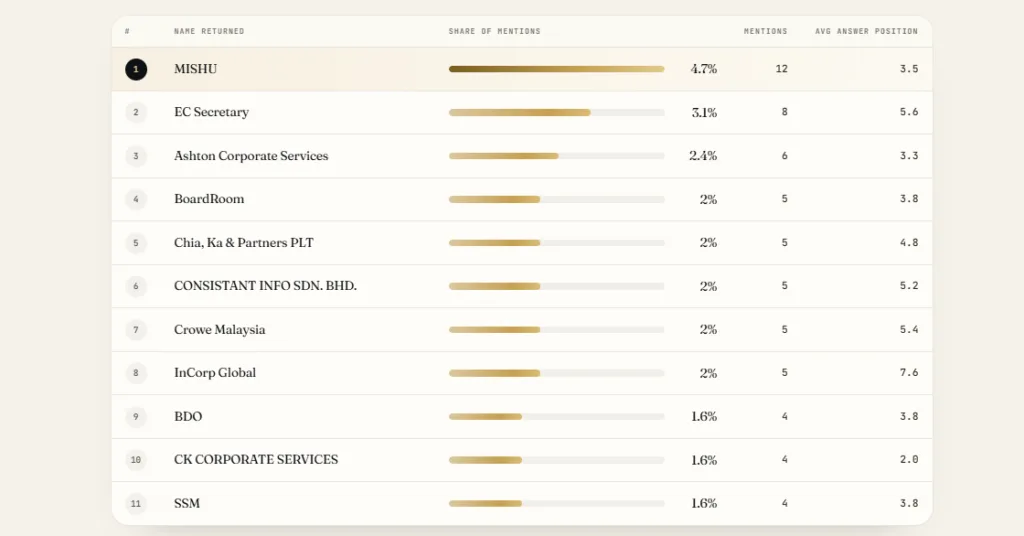
Of course, rankings change all the time and who knows how accurate it even is to begin with.
That said, we still found it heartening. MISHU today offers a far broader range of services than when we started in 2020, but the one we began with – digital Company Secretarial services – is still a core offering. We don’t want to be seen as just a CoSec, but we still want to be seen as the CoSec for SMEs in Malaysia.
And to walk the walk, we’ve gone through the past 24 months of internal search data to come up with what we think is the most complete list of questions on Company Secretaries in Malaysia.
Then we locked the door and forced our team to answer them all 🙂
Basics

What is a Company Secretary?
Companies in Malaysia are subject to legal requirements under the Companies Act.
It’s not realistic to make shareholders and directors – whose expertise is mostly in doing business – to be experts on statutory compliance. However, at the same time you can’t just let them get away with breaching the Act by pleading ignorance.
That’s where a Company Secretary comes in. We are a company officer appointed to keep it compliant with the Companies Act 2016 and its filings with the Companies Commission of Malaysia (SSM).
We maintain statutory records, prepare resolutions, lodge changes and annual returns with SSM, and advise directors on their compliance obligations.
What does ‘CoSec’ mean?
CoSec is a colloquial term for Company Secretary. We’re not sure if it’s just Malaysia that uses it, but we use it a lot especially in informal settings.
What does a Company Secretary do?
For a typical Sdn Bhd, a Company Secretary will, at the very least:
- incorporate the company and lodge its first documents with SSM
- prepare directors’ and shareholders’ resolutions
- lodge changes to directors, shareholders, share capital and addresses
- file the annual return and lodge financial statements each year
- keep the company’s statutory registers up to date
- remind directors of deadlines and advise on compliance
Depending on the company’s needs, a CoSec will also be the one drafting various resolutions, and handling the accounting needs.
What are a Company Secretary’s duties under the Companies Act 2016?
The Act requires the Company Secretary to help the company and its directors meet their statutory obligations, including:
- keeping the registers of members, directors, officers and beneficial owners
- lodging documents with SSM on time
- recording meeting proceedings and resolutions, and
- keeping records at the registered office or another notified location
Sections 235 to 242 cover the appointment, qualifications and conduct of Company Secretaries.
Is a Company Secretary the same as a corporate secretary?
Yes. ‘Corporate secretary’ is more common in other countries while Malaysia uses ‘Company Secretary’ but both terms describe the same role.
How is a Company Secretary different from an office secretary?
An office or personal secretary provides administrative support such as scheduling, correspondence and filing, and sometimes double as personal assistants for a senior company member.
A Company Secretary is a professionally qualified statutory officer of the company who keeps it compliant with SSM and the Companies Act 2016.
The two roles share a name but little else.
We used to get inquiries from people looking for office secretaries all the time, but thankfully those have stopped!
Is a Company Secretary a director or an officer of the company?
A Company Secretary is an officer of the company, but not a director. We don’t make business decisions or vote at board meetings. Their job is to make sure the board’s decisions are properly recorded and that the company meets its legal obligations.
That said, a director can also be appointed as a CoSec provided they are qualified, BUT when there is a document that requires signatures of both director and Company Secretary, they cannot be the same signatory for both roles.
This includes things as basic as a resolution to open a company bank account, so in practice a one man shareholder – director Sdn Bhd should have a separate CoSec.
What is the Company Secretary’s relationship with the directors?
The board appoints the Company Secretary, and the Company Secretary reports to the board. We advise directors on what the law requires, prepare and record resolutions, and act as the link between the company and SSM.
We are duty bound to let the board know if something they plan to do may breach the Act, but we have no power to actually tell them what to do.
That’s why typically when the board goes against the CoSec’s advice on a serious enough matter, we will resign.
What does a Company Secretary do at board meetings?
The Company Secretary prepares the agenda and notice, makes sure the meeting follows the company’s constitution, records the minutes, and prepares any resolutions passed.
Many private companies make decisions by written resolution instead of holding meetings, and the Company Secretary prepares those too.
Does a Company Secretary handle accounting and tax?
Bookkeeping, tax filing and audits are done by accountants, tax agents and auditors, and the Company Secretary works alongside them, for example by preparing resolutions to approve the accounts and lodging the audited financial statements with SSM.
Some firms offer all these services as a bundled package, but each is carried out by a different employee.
What are the different types of Company Secretary?
There are three main types:
- In-house: an employee of the company, common in public listed companies and large groups
- Group Company Secretary: an in-house Company Secretary who looks after several related companies
- Outsourced / online: a Company Secretary from a Company Secretarial firm, which is how most Sdn Bhds handle it
What role does a Company Secretary play in ESG reporting?
For listed companies, the Company Secretary may help the board meet Bursa Malaysia’s sustainability reporting requirements by coordinating disclosures and documenting governance processes.
Private companies in Malaysia have no mandatory ESG reporting, and as they are MISHU’s target client base, ESG reporting isn’t something we cover.
We do scold team members who don’t turn off the office lights, though.
Legal requirements

Does every Sdn Bhd need a Company Secretary?
Yes. Every company incorporated under the Companies Act 2016 must have at least one Company Secretary. That includes a Sdn Bhd with just one director and one shareholder, and no size or revenue threshold exempts a company.
Furthermore, all Sdn Bhds must appoint a CoSec within 30 days of incorporating, and from there on cannot leave the position vacant for more than 30 days.
Does a sole proprietorship or partnership need a Company Secretary?
No. Sole proprietorships and partnerships (collectively SSM Enterprises) have significantly easier compliance requirements that don’t need a Company Secretary – it’s one of the main arguments in favour of choosing an Enterprise over a Sdn Bhd.
A Limited Liability Partnership (LLP) doesn’t need one either, but it must appoint a compliance officer, which is effectively a CoSec under a different name.
How soon after incorporation must a company appoint a CoSec?
The first Company Secretary must be appointed within 30 days of incorporation, and the appointment must be lodged with SSM within 14 days.
In practice, most companies have a Company Secretary from day one, because we usually handle the incorporation.
What is the penalty for not appointing a Company Secretary?
Not appointing a CoSec in 30 days defaults to the General Penalty under Section 588 of the Companies Act 2016, which includes a maximum penalty of:
- fine of up to RM50,000 for both the company and its directors
- imprisonment for a term up to 3 years for individual officers, or
- both
In practice, SSM rarely immediately comes down on directors with the Hammer of Thor on the 31st day. Most commonly, they start with administrative fines between RM1,000 – RM3,000 as a warning for the directors to hurry up and appoint a CoSec.
We should mention that the cost of appointing a CoSec can be lower than SSM fines, so there’s just no excuse not to appoint one.
Does a Company Secretary need to live in Malaysia?
Yes. A Company Secretary must be a qualified individual who is at least 18 years old, and their principal place of residence must be in Malaysia.
Does a foreign-owned Sdn Bhd need a Malaysian Company Secretary?
Yes. Even a Sdn Bhd that is fully foreign-owned needs a qualified Company Secretary who lives in Malaysia. Foreign owners almost always use an outsourced Company Secretarial firm for this. Separately, the company also needs at least one director who ordinarily resides in Malaysia.
Can a director also be the Company Secretary?
Yes, if the director is qualified to act as a Company Secretary. However, one person can’t sign a document in both capacities where the law requires both a director and a Company Secretary to sign, so most companies keep the roles separate.
In other words, if you have at least two directors and one of them is qualified to be a CoSec, this arrangement is possible.
Can a lawyer be a Company Secretary?
Yes. Advocates and solicitors who are members of the Malaysian Bar, the Sabah Law Society or the Advocates Association of Sarawak are among the professionals who qualify.
Like every other CoSec, they must also register with SSM and hold a practising certificate.
Does a company need a full-time Company Secretary?
No. The Act requires a company to have a Company Secretary, not a full-time employee in the role. Most Sdn Bhds use an outsourced Company Secretary on a retainer.
Is a Company Secretary personally liable for the company’s debts?
No. A Sdn Bhd’s debts belong to the company, not to its officers, so a Company Secretary isn’t liable for them just because they hold the role.
What can a Company Secretary be held liable for?
A Company Secretary can be personally liable for offences as an officer in default which includes:
- failing to lodge required documents
- making false statements in filings, or
- acting without a valid practising certificate
This is all a fancy way to say we can be held responsible for not doing our job properly!
Licensing & qualifications

Who is qualified to be a Company Secretary in Malaysia?
A person qualifies by one of two routes.
Firstly, they can be a member of the following professional bodies listed in the Fourth Schedule of the Companies Act 2016:
- Malaysian Institute of Chartered Secretaries and Administrators (MAICSA)
- Malaysian Institute of Accountants (MIA)
- Malaysian Bar
- Malaysian Association of Company Secretaries (MACS)
- Malaysian Institute of Certified Public Accountants (MICPA)
- Sabah Law Society (subsequently substituted from Sabah Law Association in August 2022)
- Advocates Association of Sarawak
Otherwise, they may be licensed by SSM under section 20G of the Companies Commission of Malaysia Act 2001.
In both cases, they must also hold an SSM practising certificate and must not be disqualified under section 238.
Does it make a difference if a CoSec is part of a professional body?
A licensed Company Secretary qualifies through SSM’s licensing process, while a member of a professional body qualifies through membership of a body such as MAICSA, MIA or MICPA, or through the Malaysian Bar.
Both must register with SSM and hold a separate practising certificate, regardless of which route they qualified through.
In practice, a Company Secretary who is also a member of a professional body will probably be able to advise on matters pertaining to their industry, while being just as well-versed in the Companies Act as a CoSec who went through the SSM-only route.
Is there an official list of licensed Company Secretaries in Malaysia?
No official body ranks Company Secretarial firms, but professional bodies such as MAICSA keep member directories (but again these will have the individual CoSec, not the firm they work for).
The simplest check is to ask any Company Secretary you’re considering for their practising certificate number.
How do I check whether a Company Secretary is registered with SSM?
Ask for their SSM practising certificate number and expiry date, then confirm it with SSM. If they qualified through a professional body, you can also check their membership with that body.
How do I find out who a company’s Company Secretary is?
Buy the company’s profile from SSM. It lists the company’s current officers, including the Company Secretary, and its registered address.
We recommend MyData SSM.
Appointing, changing & removing a CoSec

How do I appoint a Company Secretary?
First, the board appoints the Company Secretary by directors’ resolution.
The CoSec then signs a consent to act as their CoSec and lodges the appointment with SSM within 14 days.
For a new company, this is usually done as part of incorporation.
How do I change my Company Secretary?
The usual steps are:
- engage the new Company Secretary
- pass a board resolution appointing the new Company Secretary and accepting the outgoing one’s resignation, or removing them
- get the new Company Secretary’s signed consent to act
- lodge the change with SSM within 14 days
- arrange the handover of statutory records
If the board of directors cannot agree to change Company Secretaries, however, the process becomes much less straightforward, and sometimes reaches a deadlock.
How do I remove a Company Secretary?
The board can remove a Company Secretary by resolution, and the change must be lodged with SSM within 14 days.
The board then has 30 days to appoint a new Company Secretary.
Does changing the Company Secretary need a board resolution?
Yes. Appointing and removing a Company Secretary are board decisions, so the change needs a directors’ resolution. Your new Company Secretary usually prepares it.
How long does it take to change Company Secretaries?
Once the resolution and consent are signed, lodging the change with SSM is quick, and it must be done within 14 days. The record handover from the outgoing Company Secretary takes longer and depends on how cooperative they are.
What happens to my company records when I switch CoSecs?
Your statutory registers, minutes and resolutions belong to the company, not the Company Secretary, so the outgoing Company Secretary should hand them over.
If any are missing, your new Company Secretary can help rebuild them from SSM’s records and your own files.
Can I ask a former Company Secretary for past resolutions and records?
Yes. The company owns its records and is entitled to them. If a former Company Secretary is slow to respond, a written request from the board usually resolves it. Some firms charge for retrieving archived documents.
What does ‘reassignment of Company Secretary’ mean?
This is just the official SSM term for switching from one CoSec to another. The company appoints a new Company Secretary and the outgoing one resigns or is removed.
What does the Company Secretary do when a director resigns?
The Company Secretary records the resignation, updates the register of directors, and lodges the change with SSM within 14 days. If the resignation leaves the company without a resident director, we will advise the board to appoint a replacement.
Annual compliance & documents

What annual filings does a Company Secretary handle?
The two main annual filings are:
- annual return: lodged with SSM within 30 days of each anniversary of incorporation
- financial statements: circulated to members within 6 months of the financial year end for a private company, then lodged with SSM within 30 days of circulation
The financial statements will also have to be audited unless they fall under SSM’s exemption threshold.
What is the difference between an annual return and an annual report?
An annual return is a short statutory filing with SSM confirming the company’s details, such as its officers, shareholders and registered address.
An annual report is a longer document mainly published by listed companies, containing the financial statements and the directors’ report.
A Sdn Bhd files an annual return and lodges financial statements, but doesn’t publish an annual report in the listed-company sense.
What statutory records does a Company Secretary keep?
The main records are the registers of members, directors and Company Secretaries, and beneficial owners, along with minutes, resolutions, the constitution if the company has one, and copies of documents lodged with SSM.
Does a CoSec have to sign company documents and resolutions?
It depends – some lodgements and certified copies need the Company Secretary’s signature, while most resolutions are signed by the directors or shareholders and then certified by the Company Secretary.
Do I need meeting minutes for a written resolution?
No. A written resolution replaces a meeting, so the signed resolution itself is the record. Keep it with the company’s minute book.
What are certified true copies (CTC), and why would I need them?
A CTC is a copy of a company document, such as a resolution, the constitution or a register, that the Company Secretary certifies as matching the original. Banks, government agencies and business partners often ask for CTCs when you open accounts or apply for licences.
What does a CoSec do when a company declares dividends?
The Company Secretary prepares the directors’ resolution declaring the dividend, makes sure the board has carried out the required solvency test, and updates the company’s records.
What is beneficial ownership reporting, and who handles it?
Companies must keep a register of their beneficial owners, meaning the individuals who ultimately own or control the company, and report this information to SSM.
These requirements were tightened by the Companies (Amendment) Act 2024 requiring the Company Secretary to collect this information and make the filings.
What documents does a CoSec need to incorporate a company?
A Company Secretary will usually need:
- the proposed company name
- identity documents for each director and shareholder (MyKad for Malaysians, passport for foreigners)
- residential addresses and contact details
- a description of the business activity and the registered address
- the share capital and shareholding structure
Depending on the individual or firm’s own internal policies, they may request additional documents – for example, MISHU may request proof of existing businesses when taking on a foreign client.
Can a Company Secretary help with dormant companies or striking off?
Yes. A dormant company must still file its annual return and financial statements, although some qualify for audit exemption.
To close a company, the Company Secretary can apply to SSM to strike it off under section 550, as long as the company meets the conditions.
Can a Company Secretary provide a nominee or resident director?
Yes, some Company Secretarial firms help foreign-owned companies arrange a resident director, but it’s separate from Company Secretarial work and comes with its own legal responsibilities.
Due to several bad experiences in the past, MISHU ourselves no longer offers this service – but if you can find one, we’d be happy to help you with everything else!
Fees & costs

How much does a Company Secretary cost in Malaysia?
In brief, a Company Secretarial plan consists of five main parts:
- monthly retainer fee
- Annual Submissions
- essential resolutions
- additional resolutions
- legal document drafting
Together, they make up the lion’s share of what you’re paying for, and it typically ranges from RM1,200 to RM3,500 a year depending on what you need out of a CoSec.
For reference, MISHU’s own CoSec plans for local companies range from RM80 to RM200 a month, or RM960 to RM2,400 a year.
Which one you need and what’s a fair price depends on too many factors to list in a guide like this – see our CoSec fee structure breakdown for full details.
What is a ‘CoSec fee’ on my invoice for?
It’s the fee for Company Secretarial services, usually the retainer that covers acting as your named Company Secretary, maintaining your records, filing the annual return and giving general compliance advice. Ask your Company Secretary for a breakdown if the invoice doesn’t say what’s included.
What is the difference between a Company Secretarial fee and a provision for Company Secretarial fees?
In your accounts, the Company Secretarial fee is the amount actually invoiced and paid.
A provision for Company Secretarial fees is an estimate your accountant records for fees the company owes for the period but hasn’t been billed for yet.
Are there charges on top of the monthly or annual retainer?
Usually yes for the basic plans, while more premium options may provide for additional services at no extra cost (well, they do, just not on an ad-hoc basis).
All plans include a retainer fee, but a basic plan will typically impose ad-hoc charges for non typical resolutions such as changes of directors or shareholders, share allotments, change of company name, dividend resolutions and striking off.
Ask for a fee schedule before you sign.
Is a retainer or pay-per-service better for a small company?
It’s the same as any other business process.
All companies must either keep a CoSec on retainer or appoint an in-house officer due to SSM requirements. Pay-per-service can work for a dormant or smaller company, and as they grow in complexity and frequency of CoSec services, an in-house option may become more cost-effective.
How much does a CoSec charge for a dividend declaration?
This is usually an ad hoc fee on top of the retainer, and it varies by firm.
Digital & outsourced services

What is a digital or online Company Secretary?
A digital Company Secretary handles signatures, documents and filings online instead of on paper or in person. To be honest, by this definition, we think almost every Company Secretary in Malaysia today is a digital CoSec because who the heck doesn’t have a computer and internet connection in 2026?
When we started in 2020 as a digital Company Secretary, this actually meant something as much of the industry was still manual.
A digital CoSec isn’t going to incorporate your company any faster, nor do we have special knowledge or insights that a regular non-digital CoSec isn’t privy to.
Is an online Company Secretary legally valid in Malaysia?
Yes. The law sets out who can act as a Company Secretary, not how they work with clients. An online Company Secretary still has to meet all the same requirements, including SSM registration, a practising certificate and residence in Malaysia.
Should I hire an in-house Company Secretary or outsource?
Most Sdn Bhds outsource as an in-house Company Secretary is a full-time salaried role usually only worth it for listed companies or large groups with a lot of corporate activity.
An outsourced Company Secretary costs a fraction of a salary and covers everything a typical SME needs.
Do I need Company Secretary software?
Not if you outsource. Your Company Secretary will use their own systems. Company Secretarial software is mainly used by Company Secretarial firms and in-house teams that manage many companies.
Choosing a Company Secretary

How do I choose a Company Secretary in Malaysia?
The ultimate green flag is of course a CoSec that offers fast responses and timely deadline reminders, but this isn’t something you can tell before you engage them!
It’s very hard to go wrong, but generally look for:
- a valid SSM practising certificate
- clear pricing that shows what the retainer covers and what costs extra
- the option to sign and receive documents online
- no long lock-in period
This already covers many service providers, so if you want to take it one step further, we’d say to pick a CoSec who is located close to where you live or do business so it’s easy to visit their offices, and a CoSec who can help you with post-incorporation steps such as the all important PBT business license.
For example, in our guide to finding the best Company Secretary in Petaling Jaya we specially mention that it sure would help if your CoSec had a licensing expert who could help with your MBPJ business license application!
Does my Company Secretary need to be in the same city as me?
No. Most Company Secretarial work can be done online, so a Company Secretary in Kuala Lumpur can serve a company in Johor Bahru or Penang – the only location requirement is that they live in Malaysia.
But as we mentioned in the previous answer, all other things equal, a CoSec that’s close to you has its own benefits.
Can I use my Company Secretary’s address as my registered office?
Often, yes. Many Company Secretarial firms let clients use their office as the registered office address, where official notices are received and statutory records can be kept.
Should I use a Company Secretarial firm or individual Secretary?
A firm usually gives you more continuity, because if your assigned Company Secretary leaves, someone else in the firm takes over. An individual Company Secretary may be cheaper, but you’re relying on one person being available.
Do Labuan companies need a different kind of Company Secretary?
Yes. Labuan companies are governed by the Labuan Companies Act 1990, not the Companies Act 2016, and generally need a Company Secretary arranged through a Labuan trust company.
What should I ask a Company Secretary before engaging them?
Ask what the retainer covers, what costs extra, and whether there’s a minimum contract period, and how they’ll remind you of deadlines and whether they will also manage your SSM filings under the same fee or if they charge separately.
You can also ask if they can help you with additional services beyond a CoSec’s duties such as nominee director appointment, business licenses, expatriate visas, or whatever you believe you’ll need.
Working with MISHU

Is MISHU a licensed Company Secretary?
Yup. MISHU began in 2020 as a digitalised Company Secretarial firm. Company Secretarial work is still a core service, now run by its own dedicated department.
What Company Secretary packages does MISHU offer?
MISHU offers several Company Secretarial plans to suit companies of different sizes and activity levels. The plans range from RM80 to RM200 a month, or RM960 to RM2,400 a year.
Does MISHU lock clients into long contracts?
No. MISHU doesn’t lock clients into long contracts, though we do charge annually rather than monthly.
Can I work with MISHU entirely online?
Generally, yes. The initial incorporation can be done without visiting our office, but as part of our KYC (know your customer) process, we may sometimes ask for extra proof of identity or address before we take on a company or act on certain changes.
The same applies to most of our Company Secretarial work thereafter, and is meant to protect you as well as us, because it confirms that the instructions really come from the company’s directors and shareholders.
How do I switch my Company Secretary to MISHU?
We explain it in full in our CoSec switch guide, but essentially you contact us and we’ll prepare the board resolution, get the consent to act signed, and lodge the change with SSM within 14 days.
We also handle the handover of records from your current Company Secretary.
Careers as a Company Secretary

How do I become a Company Secretary in Malaysia?
Qualify through a professional body such as MAICSA, MIA or MICPA, or through SSM’s licensing route. Then register with SSM and get a practising certificate.
Many people start as Company Secretarial executives or assistants and gain experience while they study for their qualification.
What courses and qualifications do I need?
Most entry-level roles ask for a diploma or degree in business administration, corporate administration, law or a related field. Working toward a MAICSA (ICSA) qualification counts in your favour, and you need a full qualification or an SSM licence to act as a Company Secretary yourself.
What does a Company Secretary’s job involve day to day?
Typical tasks include preparing resolutions and minutes, lodging documents with SSM through MyCoID and MBRS, keeping statutory registers up to date, tracking client deadlines, and answering directors’ questions on compliance. Senior Company Secretaries also advise boards on governance and handle more complex work such as striking off companies, winding up, and late lodgements.
Are there Company Secretary internships in Malaysia?
Yes. Company Secretarial firms, audit firms and corporate services providers regularly take interns, especially students in business, law or corporate administration.
We can’t personally remember the last time our CoSec department took on interns though.
Do Company Secretaries need professional indemnity insurance?
It isn’t a general legal requirement, but many firms and individual practitioners carry it to protect against claims from honest mistakes.
Is MISHU hiring Company Secretaries?
You can find current openings at MISHU on our careers page.
Let MISHU be your Company Secretary

On top of Company Secretary services, MISHU offers a comprehensive suite of business solutions including everything from accounting to HR and business licensing. If you’re an SME looking for a one-stop Company Secretary in Malaysia, MISHU may well be your best choice.