

The Digital Nomad’s Guide To De Rantau Pass Applications (2026)
If your work isn’t especially digital nomad-centric, see our list of 16 long-term Malaysian visa options to find the right fit for you.
The DE Rantau Nomad Pass is a long-term visa by the Malaysia Digital Economy Corporation (MDEC) that allows eligible foreign freelancers and remote workers – aka digital nomads – to live in Malaysia for 12 – 24 months with their families.

If you are a freelancer or remote worker seeking a long-term base in Southeast Asia, this guide explains why Malaysia and DE Rantau is a strong contender, covering:
- who can apply and how much you need to earn
- required documents for freelancers and remote workers
- official visa and immigration fees
- how long approval really takes
- application and endorsement steps
- what to do if you’re already in Malaysia
- bringing your family, tax, renewals, and
- an offer to let us handle it for you 🙂
Let’s begin.
Table of Contents
- DE Rantau overview
- Eligibility requirements
- Required documents
- Sponsor and personal bond
- Fees
- Application processing time
- Steps in the DE Rantau application process
- Step 1: Register an MD account
- Step 2: Choose De Rantau Digital Nomad (Foreign)
- Step 3: Choose to apply as freelancer / remote worker
- Step 4: Complete application, submit documents and pay
- Step 5: Wait for approval
- Step 6: Get your eVISA or VDR if you need one
- Step 7: Enter Malaysia through a manual immigration counter
- Step 8: Complete endorsement and get your e-Pass
- If you’re already in Malaysia
- Bringing dependents
- Things to know once you’re in Malaysia
- Tax on DE Rantau
- Renewal and what happens after 24 months
- If your application is rejected
- Let MISHU help with your De Rantau application
- 💡 FAQs on DE Rantau Nomad Pass
DE Rantau overview
Fun fact: ‘Rantau’ comes from the Malay word ‘merantau’, which means leaving home to travel, gain experience or make a living somewhere new. So it’s basically a pass for explorers, which is pretty cool!

On paper, DE Rantau issues a Malaysian Professional Visit Pass (PVP), but it differs so much from a conventional PVP that it’s essentially a completely different pass.
| Who it’s for | Foreign freelancers and remote workers over 18, of any nationality except Israel |
| Minimum income | USD 24,000 a year for tech roles, or USD 60,000 a year for non-tech roles |
| Pass duration | 3 to 12 months, renewable for up to 12 more months (24 months maximum) |
| Processing fee | RM1,080 per applicant and RM540 per dependent (non-refundable) |
| Processing time | 6 to 8 weeks officially, plus about 1 week for the e-Pass after endorsement |
| Family | Spouse or common-law partner, children under 18, disabled children of any age, and your parents |
| Where to apply | Online at mdec.my/derantau, from inside or outside Malaysia |
Eligibility requirements

MDEC recognises two categories of DE Rantau Nomad Pass applicants:
- Freelancers: Self-employed individuals or contractors who serve clients and manage their own income
- Remote workers: Employees of a foreign company that is not registered in Malaysia, with a flexible arrangement that lets them work remotely
In both groups, the applicant must be over 18, hold a valid passport from any country except Israel, and meet the income requirement for their qualifying profession as a freelancer or remote worker.
You don’t need to be in Malaysia to apply – if you’re already here, we cover what it means further down.
Qualifying professions

DE Rantau separates qualifying professions into tech and non-tech, and the income bar for non-tech roles is more than double. Here’s MDEC’s full list so you can check exactly where your job fits.
| Category / income | Qualifying roles |
| Tech Profession (Min. USD 24,000 per year) | – software engineers and backend engineers – UX and UI – cloud and cybersecurity – blockchain, AI, machine learning and data-related roles – digital marketing – digital content creation and development |
| Non-Tech Profession (Min. USD 60,000 per year) | – CEO, founder, managing director or president – chief operations officer – business development or growth manager – marketing manager – chief financial officer, finance manager or accountant – sales manager – customer success manager – human resources manager – legal counsel – public relations manager – consultant – customer service manager, representative or customer success specialist – communications and public relations manager – administration manager – technical writer – tax specialist or tax accountant – production manager – supply chain manager – any equivalent position |
Some additional notes:
- digital marketing applicants must also submit a marketing portfolio or performance report
- content creators who earn from digital platforms can still apply as freelancers
- to founders applying as a remote worker in their own company, the company employing you as a c-suite executive or director cannot registered in Malaysia
To readers planning on incorporating a tech company in Malaysia itself, the Malaysian Tech Entrepreneur Programme may suit you better.
If you’re unsure which category you fall into, feel free to ask us instead of risking a rejected application. Otherwise, let’s look at the supporting documents needed.
Required documents
Supporting documents for freelancers and remote workers are very similar, with differences mainly related to proof of income.
For all applicants
- passport (all pages from cover to cover, with at least 6 empty pages and at least 14 months validity)
- latest CV, in your own format or LinkedIn format
- last 3 months bank statements
- letter of good conduct from the relevant authority in your home country or current country of residence
- personal bond, completed using the prescribed form (see the sponsor section below)
- highest education certificate, scanned as a PDF
- Inland Revenue Board of Malaysia (LHDN) tax registration slip, which you can register for on MyTax
- medical insurance enrolment certificate, valid in Malaysia and covering any dependents
- marketing portfolio or performance report, if you’re applying under a digital marketing role
Proof of medical insurance can be submitted after approval, before your pass is issued. It needs at least 3 months validity and must stay valid throughout your pass period.
For freelancers

On top of the documents above, freelancers need:
- signed client contracts or freelance agreements, with foreign or Malaysian clients, stating the scope of work, duration and payment terms
- invoices issued in the last 3 months
- proof of payment for that work, such as PayPal, Stripe, Wise or bank transfer records
- portfolio, website or client testimonials (optional, but they help show your work is genuine)
Your contracts must have started at least 3 months before you submit your application. A brand new contract won’t count, even if it runs for a year. Your bank statements should also show consistent income above the threshold for your profession.
For remote workers

On top of the documents for all applicants, remote workers need:
- a signed employment contract that states your remote work arrangement, job title and responsibilities, contract duration, salary in USD or an equivalent currency, and your employer’s name and foreign business details
- payslips for the last 3 months, showing regular monthly income
- last 3 months income statement or latest tax return
- a letter from your employer confirming your remote work status, employment terms and income (optional, but strongly recommended)
Your employment must have started at least 3 months before you submit your application, and MDEC prefers that your contract stays valid for at least 6 months from the date you apply. Your employer must not be registered in Malaysia, and your bank statements must show salary deposits that match your payslips.
Notes
- documents must be clear, legible and in PDF format
- documents must be in English or accompanied by a certified English translation
- name and income details must be consistent across documents
- incomplete, unverifiable or inconsistent documents can delay your application or get it rejected
- MDEC can ask for additional documents at any point
Small mismatches, like a different name spelling or a salary that doesn’t line up with your bank deposits, are easy to miss. Check every document side by side before you submit.
Sponsor and personal bond
Every DE Rantau holder needs a sponsor, which is a local organisation that vouches for your stay in Malaysia and takes responsibility for your maintenance and repatriation.
In most cases, MDEC can act as the applicant’s sponsor, in which case they will be required to:
- sign a personal bond agreement with MDEC, and
- pay a security bond to MDEC online, which is refunded in full when your pass expires
The personal bond or declaration form must carry a RM10 revenue stamp and be endorsed by LHDN, while the security bond amount depends on nationality:
| Security bond | Nationalities |
| RM2,000 | USA, Canada, Colombia, Angola, Burkina Faso, Burundi, Cameroon, Central African Republic, Côte d’Ivoire, Democratic Republic of the Congo, Djibouti, Equatorial Guinea, Eritrea, Ethiopia, Ghana, Guinea-Bissau, Liberia, Mali, Mozambique, Niger, Nigeria, Republic of the Congo, Rwanda, Western Sahara |
| RM1,500 | Australia, China, Taiwan, Vietnam, Brunei, Saudi Arabia, Iran, Iraq, Tunisia, Europe, other African countries, British C.I., Portugal C.I., and any nationality not listed in this table |
| RM1,000 | Japan, South Korea, Hong Kong, Macao |
| RM750 | India, Pakistan, Bangladesh, Sri Lanka, Nepal, Myanmar, Philippines |
| RM500 | Indonesia |
| RM300 | Thailand |
| RM200 | Singapore |
Fees
Assuming you handle your own DE Rantau application, all payments are made online to Malaysia Digital Economy Corporation Sdn Bhd, and these are the costs to keep in mind:
| Fee | Amount | When you pay |
| Processing fee (main applicant) | RM1,080, including 8% SST | On submission |
| Processing fee (each dependent) | RM540, including 8% SST | On submission |
| Immigration pass fee | RM90 for every 3 months, or RM360 for 1 year | At endorsement |
| Multiple Entry Visa | Varies by nationality | At endorsement, if applicable |
| Security bond (if MDEC sponsors you) | RM200 to RM2,000 depending on nationality, refundable | Before endorsement |
| Revenue stamp on personal bond | RM10 | Before endorsement |
As of October 2026, processing fees, Immigration pass fees and Multiple Entry Visa are non-refundable for all applications whether approved, rejected, cancelled or withdrawn.
And of course, if you use a third-party provider, there will be a professional service charge on top of that which varies between providers and the complexity of your case.
Example of MDEC application fees

Say you’re an Australian freelancer applying for a 12-month pass, with MDEC as your sponsor:
- RM1,080 processing fee
- RM360 immigration pass fee
- RM10 revenue stamp, and
- RM1,500 security bond (refunded when your pass expires)
That’s RM2,950 upfront, of which RM1,500 comes back to you, plus Multiple Entry Visa charges, and each dependent adds a RM540 processing fee.
Application processing time
MDEC’s official processing time is 6 to 8 weeks from when your completed application is received, and once you submit your endorsement, the e-Pass is usually issued within 1 week.
However, a quick online search will show you that it has always taken significantly longer in practice!
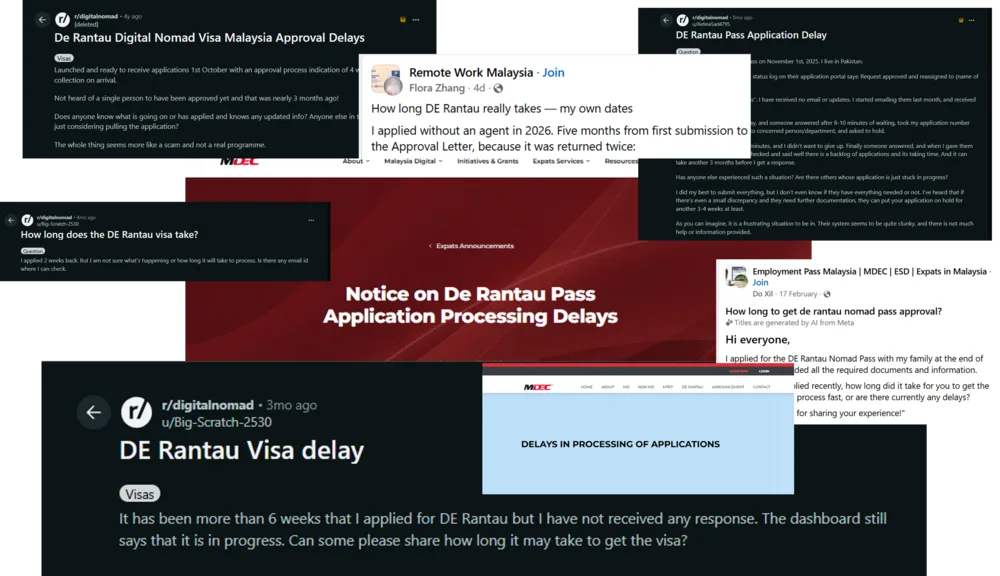
We’ve been helping expats apply for De Rantau visas for years, and even straightforward applications can take significantly longer simply due to the high volume of applications. It’s a popular visa for nomads who want a base in Southeast Asia, and since the start to the present, processing times are a challenge.
Add on top of that the possibility that MDEC may request additional supporting documents or raise concerns, and a more realistic timeline is 18 – 24 weeks.
Steps in the DE Rantau application process

We’re laying this out as if you were handling it yourself, and there are eight main steps, not including step 0 which is preparing your documents!
Step 1: Register an MD account

All applications are made online through MDEC’s DE Rantau page, which leads you to the MD portal registration page. Set up your account there.
There’ll be the usual email verifications, which we’ll trust you to navigate yourself since this is an application for a digitally savvy business after all!
Step 2: Choose De Rantau Digital Nomad (Foreign)

You can check out those other programmes later; pick De Rantau for now and hit ‘proceed’!
Step 3: Choose to apply as freelancer / remote worker

The page just repeats what we’ve shared above, so scroll to the end and tick the right checkbox depending on if you’re a freelancer or employee.
Step 4: Complete application, submit documents and pay

You will be directed to a DE Rantau application form, which we should note is quite extensive, so give yourself about an hour to fill everything in.
You’ll pay the non-refundable processing fee of RM1,080, plus RM540 per dependent, when you submit.
Step 5: Wait for approval
Applications typically take several weeks to be processed, and if yours is successful, you will be issued an approval letter through the MD portal. Keep an eye on your registered email too, since that’s where MDEC sends requests for extra documents, and missing one can delay your application.
Otherwise, you should receive a notification that looks something like this.
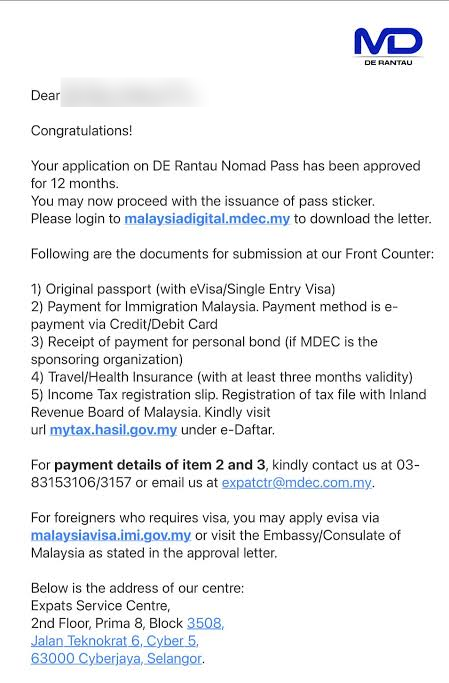
Your approval letter is valid for 6 months and can’t be extended, so you need to complete endorsement within that window. Otherwise, you’ll have to submit a new application.
Step 6: Get your eVISA or VDR if you need one
Your approval letter states how you should enter Malaysia, and if your nationality needs a visa, apply for an eVISA or a Visa with Reference (VDR) through a Malaysian embassy or consulate before you travel.
If you’re in Malaysia on a tourist visa when you’re approved, you’ll need to leave and re-enter with the right visa.
Step 7: Enter Malaysia through a manual immigration counter
This one catches people out. On your first entry, go to a normal immigration counter, not the autogate. You need an immigration entry stamp for endorsement, and the autogate won’t give you one. Bring your approval letter and a copy of your VDR, if you have one.
Step 8: Complete endorsement and get your e-Pass
You must complete endorsement within 1 month of the date on your entry stamp. Log in to the DE Rantau portal, open your approved application and upload:
- your signed personal bond agreement or declaration form
- a copy of all your passport pages
- your latest immigration entry stamp
- your eVISA or VDR, if applicable
- health insurance covering Malaysia, with at least 3 months validity and valid throughout your pass period
- your LHDN income tax registration slip, and
- anything else MDEC or the Immigration Department asks for
Then submit and pay the immigration pass fee, any Multiple Entry Visa charge, and the security bond if MDEC is your sponsor. Your De Rantau e-Pass should be ready to download within about one week.

Stay in Malaysia until your e-Pass is issued or it could cause your application to be cancelled.
If you’re already in Malaysia
You can apply from inside Malaysia, but what happens next depends on the pass you’re on now.
On a tourist or social visit pass
You can stay in Malaysia on a valid visa while your application is processed. A tourist pass can’t be converted into a DE Rantau pass, though, so once you’re approved, you must leave Malaysia and come back with the visa or entry permission stated in your approval letter.
On an Employment Pass
If you hold an EP Category I or II that is still valid when your DE Rantau application is approved, you don’t need to leave Malaysia, but if it expires while your application is pending, you’ll need to exit.
To stay in Malaysia throughout, get a release letter from your employer and apply to shorten or cancel your EP with the Immigration Department.
On a Student Pass
A Student Pass can’t be converted either, but you can apply from Malaysia. You’ll need a release letter from your university confirming you’ve completed your studies, along with your full transcript, so your Student Pass can be shortened.
Bringing dependents
A DE Rantau visa holder can bring the following family members:
- husband, wife or common-law partner
- children, adopted children or stepchildren under 18
- disabled children of any age, verified by experts, and
- own parents
Dependents can arrive together with the principal or later, and while we can’t think of any time this has been an issue, note that their application is assessed separately, so approval is not a 100% guarantee just because the principal’s visa is granted.
Spouses on a De Rantau dependent visa are not allowed to work, and children attending school need a Student Pass arranged through the school, but homeschooled children don’t.
Things to know once you’re in Malaysia
- the pass allows multiple entries, so you can travel in and out freely
- it covers Peninsular Malaysia and the Federal Territory of Labuan only; you can still visit Sabah and Sarawak, but you’ll enter them on a tourist pass
- most Malaysian banks don’t accept a Professional Visit Pass for opening an account, so check with your bank first
- after your first entry, you can use the autogate at KLIA Terminals 1 and 2 if you register on the Malaysia Digital Arrival Card (MDAC) 3 days before you arrive
Tax on DE Rantau
Whether you pay Malaysian tax depends on your category, where your income comes from, and how long you stay. Here’s a summary of MDEC’s guidance:
| Category | Income source | Tax treatment |
| Remote worker | Outside Malaysia | No tax if you stay 60 days or fewer. Taxable from 61 days, at a rate based on your residence status. |
| Freelancer | Outside Malaysia | Taxable under Section 4(a) of the Income Tax Act 1967, subject to your residence status under Section 7. |
| Freelancer | Malaysia | 10% withholding tax (or your double tax agreement rate) for the first 182 days. After that, taxed as a resident, with the withholding tax credited when you file your return. |
Renewal and what happens after 24 months
You can renew your DE Rantau e-Pass up to 3 months before it expires, and we’d recommend doing it early to avoid any gap.
Renewals take 6 to 8 weeks to process, endorsement must be completed within 1 month of approval, and you need to stay in Malaysia until it’s done.

A renewal adds up to 12 months, and the maximum total stay is 24 months. If you’ve fallen for Malaysia by then (we don’t blame you), you’ll need a different pass to stay on. The main options are:
- MM2H, a long-term stay visa for those who meet its financial requirements
- an Employment Pass, if you take a job with a Malaysian company, or
- setting up your own Sdn Bhd and applying for an Employment Pass through it
If your application is rejected
Since 1 August 2026, MDEC no longer accepts appeals for rejected applications, and the processing fee isn’t refunded. You can re-apply whenever you meet the requirements, so it’s worth fixing whatever caused the rejection before you try again.
If De Rantau sounds good but not quite perfect, our guide to digital nomad visas in Malaysia compares it to several other tech-specific long-term visas so you can hopefully find a more ideal option.
If you still have unanswered questions, check out MDEC’s FAQ on De Rantau passes.
And if you still have questions after that, you can always ask MISHU for help!
Let MISHU help with your De Rantau application

We’ll be upfront: nobody can guarantee a DE Rantau approval. Not MDEC, not us, and not any agent who tells you otherwise. What we can do is make sure everything within your control is done right, including:
- checking your profession and income against the right threshold
- making sure your contract start dates meet the 3-month rule
- lining up your payslips, invoices and bank statements so the figures match
- preparing and stamping your personal bond
- helping you register with LHDN for your tax slip, and
- guiding you through your visa, entry and endorsement so nothing gets missed
Whatever your reasons for moving to Malaysia as a digital nomad, our team can help with your De Rantau Pass application to ensure a smooth process, so get in touch today!
💡 FAQs on DE Rantau Nomad Pass
-
Q: Who is eligible to apply for the DE Rantau Nomad Pass?
A: DE Rantau is open to digital freelancers, independent contractors and remote workers in digital fields such as software development, design, content creation, digital marketing and IT consulting. Applicants in non-digital professions are generally not eligible. -
Q: What is the minimum income requirement?
A: Applicants must show an annual income of at least USD24,000 from foreign sources. Income is documented through contracts, invoices or bank statements. -
Q: How much does the DE Rantau Nomad Pass cost?
A: The pass fee is RM1,080 for the main applicant and RM540 per dependent. This excludes agent fees and the cost of preparing supporting documents. -
Q: How long does a DE Rantau application take?
A: Processing typically takes around four to eight weeks from submission, assuming your documents are complete. Incomplete applications are the most common cause of delay. -
Q: What is the validity period of the pass?
A: The pass is issued for 3 to 12 months initially and can be renewed once, for a combined maximum stay of 24 months. -
Q: Can I work for a Malaysian company under DE Rantau?
A: No. Your income must come from sources outside Malaysia. Taking up local employment requires an Employment Pass instead. -
Q: Do I need health insurance?
A: Yes. Applicants must hold medical insurance with coverage valid in Malaysia for the duration of the pass. -
Q: Can I bring my family to Malaysia?
A: Yes. Your spouse or common-law partner, children under 18, disabled children of any age and your own parents can apply as dependents. The fee is RM540 per dependent. -
Q: Can my spouse work in Malaysia?
A: No. Dependents cannot work in Malaysia under the DE Rantau Nomad Pass. -
Q: Is there a minimum age for DE Rantau?
A: Yes. The main applicant must be over 18 years old. -
Q: Is the DE Rantau Nomad Pass a multiple-entry pass?
A: Yes. It allows multiple entries into Malaysia during its validity period. -
Q: Can I convert my tourist visa to a DE Rantau Pass?
A: No. You can stay in Malaysia on a tourist visa while your application is being processed, but after approval you must leave Malaysia and re-enter with the appropriate visa before completing the endorsement process. -
Q: Can I live in Sabah or Sarawak?
A: No. The DE Rantau Nomad Pass covers Peninsular Malaysia and Labuan. You can visit Sabah and Sarawak using a tourist pass, subject to the applicable entry requirements. -
Q: Do I need to pay tax in Malaysia?
A: It depends on your DE Rantau category, income source and length of stay. For example, remote workers with foreign-sourced income who stay in Malaysia for 60 days or fewer may qualify for tax exemption. See the tax section above for more details. -
Q: Can I open a bank account in Malaysia?
A: It may be difficult. Many Malaysian banks do not accept a Professional Visit Pass for bank account opening, so check the requirements directly with your preferred bank. -
Q: Can I buy property in Malaysia on a DE Rantau pass?
A: The pass itself does not grant property rights. Foreigners may purchase property subject to state minimum price thresholds, which apply regardless of visa status. -
Q: What happens after 24 months?
A: The maximum stay under DE Rantau is 24 months. If you want to remain in Malaysia longer, you will need to qualify for another suitable pass, such as MM2H or an Employment Pass. -
Q: What happens if my application is rejected?
A: You can reapply, usually after addressing whatever caused the rejection. Fees already paid are not refunded. -
Q: Can an agent guarantee my DE Rantau approval?
A: No. Neither MDEC nor any agent, including us, can guarantee approval. Every application is subject to the official assessment process. -
Q: What does rantau mean in English?
A: It comes from “merantau”, a Malay word referring to leaving home to travel, gain experience or make a living somewhere new.