

9 Professional Visa Options In Malaysia (2026)
Foreign professionals relocating to Malaysia are a diverse group, and the only real overlap across them is that their right to be here is based on having lots of expertise, money, or both!

As a result, quite a few options technically qualify as a ‘Malaysia professional visa’ and to help readers find the right one, we’ve sorted nine visas into three common use cases for skilled foreign expats:
- working for a company in Malaysia
- working for themselves, and
- semi-retiring while keeping the right to work
Each entry has a brief description, our recommendation on who it’s for, and links to full guides so readers can learn more abouto ones that fit their needs.
Let’s begin.
Working foreign professionals
These visas tie a foreign professional to a local company or organisation in Malaysia that is eligible to hire expatriates, and in fact it is the hiring / sponsoring organisation who applies for the visa.
Employment Pass

Validity: 5 – 10 years (renewable)
Use case: Skilled professionals hired full-time by a Malaysian company
This is the default visa for expatriates working as full-time employees for a company in Malaysia under one of three tiers that come with increasingly higher minimum salary requirements:
- Category 1 is for top leadership positions
- Category 2 is for mid-level managers and supervisors
- Category 3 is for junior technicians and specialists
All three tiers allow dependents,
Applications are processed by one of four different agencies, so check out our guide to Employment Passes in Malaysia to see which yours falls under.
Professional Visit Pass (PVP)

Validity: up to 12 months (renewable)
Use case: Professionals performing a service for a company in Malaysia on behalf of a foreign employer
A PVP is used to engage the service of an expat employed by a foreign company for a contractually agreed task no longer than a year, during which they must continue to receive a salary from the foreign employer and are not allowed to bring dependents.
It is used for a much broader set of use cases than EPs, including:
- visiting researchers, lecturers and academics
- artistic performances
- religious sermons
- trainee programmes with hotels and factories
- internships, and
- skill transfer programmes
One niche case is where a foreign company has a Malaysian subsidiary. As work arrangements can easily be tailored, a PVP can be used to send staff from the home country for engagements in Malaysia, bypassing the significant EP minimum salary requirements companies would usually have to meet.
For more details, see our guide to PVP applications in Malaysia.
Self-employed foreign professionals
These visas are applied for by individual professionals who have been working in Malaysia and no longer want to be tied to an employer, or foreigners who want to move to Malaysia as their base of operations.
Employment Pass Category 1

Validity: 10 years (renewable)
Use case: Foreign director / shareholder of a Malaysian company
This is the same visa from the previous section, but Category 1 EPs are also used by business owners to relocate to Malaysia as a foreign director or shareholder of their locally incorporated Sdn Bhd.
On paper it’s still a hiring organisation applying for an Employment Pass, only in this case it’s the foreigner’s company doing the applying, so practically speaking, we treat it as a separate type of visa.
If granted, it carries the same features as any other Category 1 pass.
We say ‘if’ as there are very specific conditions to qualify, so see our foreign director visa guide for details!
Residence Pass-Talent
Validity: 10 years (renewable)
Use case: Senior professionals already in Malaysia who want to stop being tied to one employer
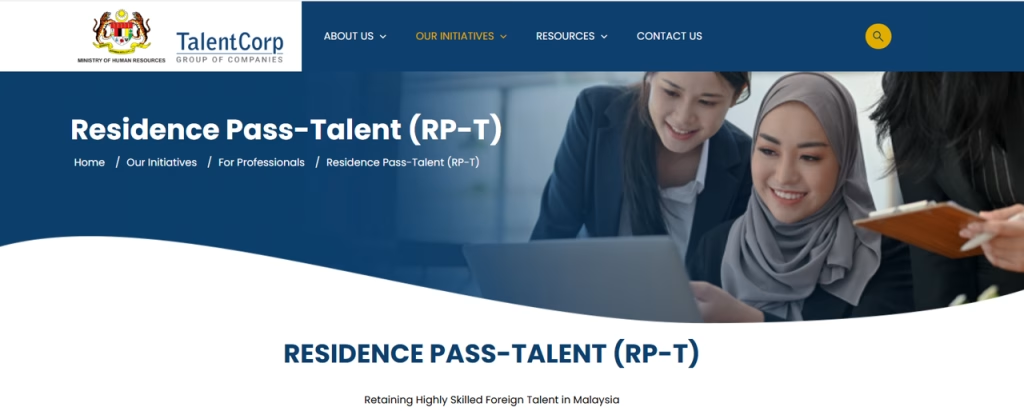
A Residence Pass-Talent visa can only be applied for by foreign professionals who have held a conventional Category 1 EP for at least three years. If granted one, not only does the holder enjoy a minimum validity period of ten years, but:
- they are free to switch employers at any time, and
- their spouse has full freedom to work
That means you get the same validity period as the highest EP category, plus two freedoms no EP grants!
Naturally, the visa comes with very high salary and qualification requirements, and if you’re curious about whether you qualify, see our guide to RP-T Malaysia.
MTEP

Validity: 1 -5 years depending on programme
Use case: Tech startup founders
Typically, a company must have RM250,000 – RM500,000 in paid-up capital before it can even be considered for an EP, which puts it out of reach for most smaller businesses.
But tech startups are given preferential treatment via the Malaysian Tech Entrepreneur Programme (MTEP).
The programme offers three tiers of visas, the lowest of which doesn’t even need a company! We don’t want to make it sound too easy, but all the visa requires is for applicants to have:
- USD11,800 in their bank account, and
- a compelling pitch deck for a tech business in a pre-approved sector
The main tradeoff is that this lowest tier does not allow dependents. The two higher tiers do (in addition to other additional privileges) but have stricter requirements.
Our guide to MTEP applications has all the information you need.
De Rantau Digital Nomad Pass
Validity: 3 – 12 months, renewable up to 24 months
Use case: Freelancers and contractors whose income comes from outside Malaysia
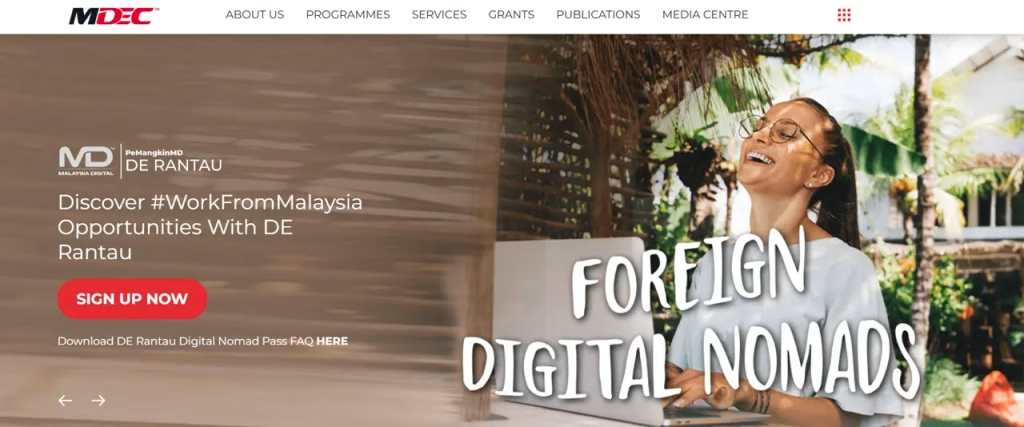
This is the pass for professionals who want to live in Malaysia as they run an overseas business or work remotely for a foreign employer.
The main requirements are:
- USD24,000 in annual income
- work in an approved digital field, and
- a contract / employment letter with at least three months validity
We’ve always thought of De Rantau as the reverse MTEP – both heavily cater to professionals in tech, but under MTEP revenue typically comes from Malaysia, while under De Rantau it’s from overseas sources.
And unlike MTEP’s lowest tier, De Rantau allows dependents!
Here’s our De Rantau application guide for those interested.
Premium Visa Programme (PVIP)

Validity: 20 years (renewable)
Use case: Foreign investors who want full working rights without an employer or a property lock
Malaysia’s PVIP is for investors and entrepreneurs who want to operate here long-term, as holders can:
- work or incorporate a foreign-owned company in Malaysia
- bring family members, and
- come and go as they please throughout the visa’s 20-year validity period
Of everything on this list, PVIP buys the most freedom, but freedom is not cheap – it requires a RM1 million fixed deposit on top of proving substantial monthly income.
For more, see our PVIP vs MM2H comparison where we put it up against another 20 year visa.
Semi-retiring foreign professionals
This last group is for professionals with the means and desire to retire in Malaysia with their family while keeping the ability to consult, sit on boards, or run a side-business locally – doesn’t mean you have to, but you can if you want to.
MM2H Platinum

Validity: 20 years (renewable)
Use case: High net worth professionals settling in Malaysia long-term and still want the option to earn here
The Malaysia My Second Home (MM2H) programme is a four-tiered visa with mandatory residential property purchase, and that property can’t be sold for at least ten years.
Its highest tier, Platinum, is the only one that allows holders to freely work and do business in Malaysia.
It also comes with the highest financial commitments of all the visas in our list, but in turn offers the longest validity period of them all – truly the option for those seeking a second home in Malaysia.
If you’re keen to know more, check out our guide to MM2H Platinum.
Sarawak-MM2H

Validity: 10 years (renewable)
Use case: High net worth professionals happy to semi-retire in East Malaysia
S-MM2H is Sarawak’s version of Malaysia’s retirement visa programme, and the key difference is holders must live in Sarawak, our largest state, located in East Malaysia.
It offers just one tier that allows limited part-time work in selected industries, and one big advantage it has over MM2H is that S-MM2H doesn’t make property purchase mandatory.
For more information, see our guide to S-MM2H vs MM2H.
Let MISHU handle your professional visa application

Directly and through our partners, MISHU has been helping expatriates secure professional visas to work and do business in Malaysia for many years, and we would be delighted to hear how we can help you.